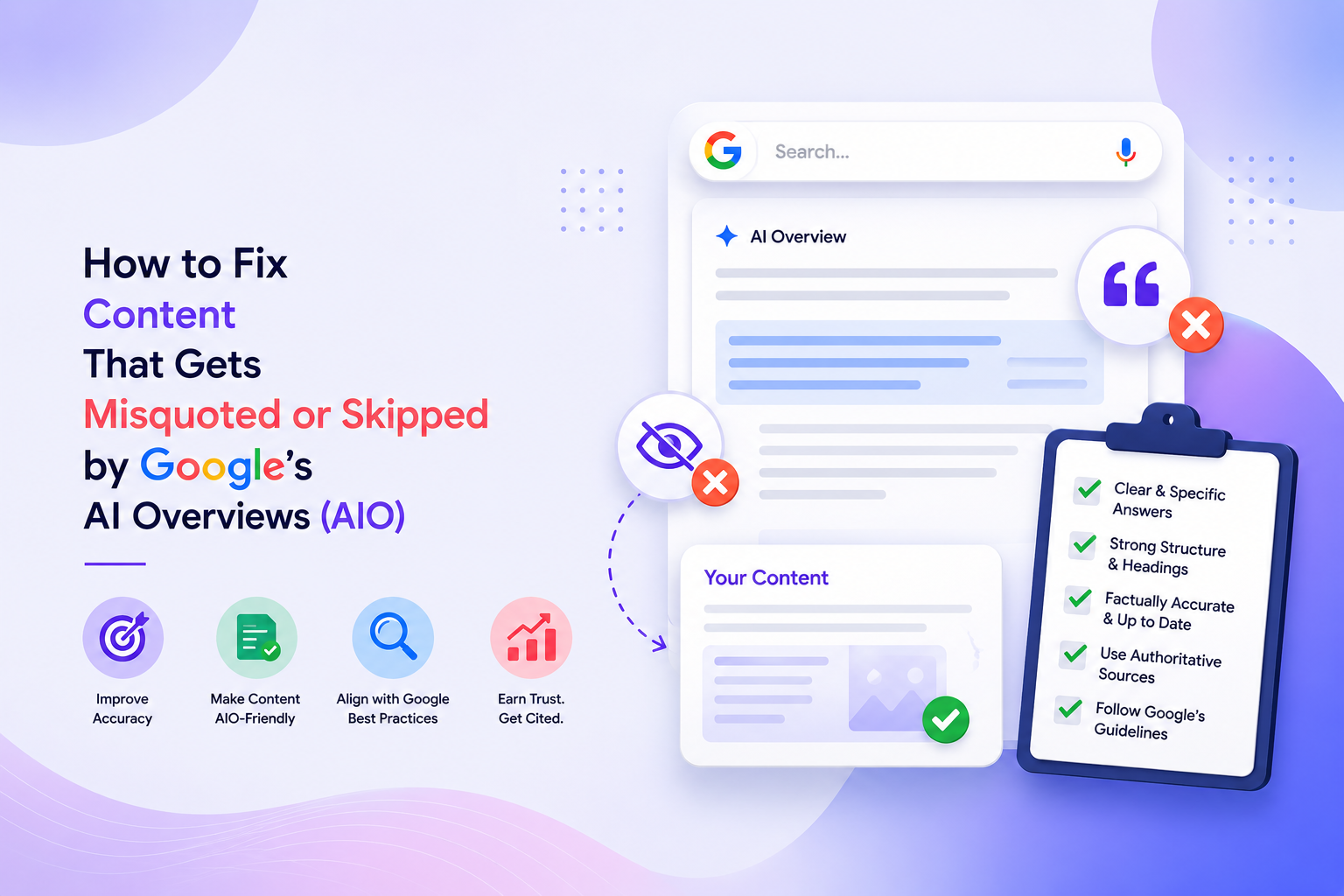
Google Search is changing rapidly, and AI Overviews (AIO) are becoming a prominent feature on search engine results pages. Instead of simply displaying a list of websites, Google now generates AI-powered summaries that answer users’ questions instantly.
While appearing in AI Overviews can significantly boost your brand’s visibility and authority, many website owners face a frustrating issue: their content is either misquoted, taken out of context, or completely ignored.
If you’ve invested time creating high-quality, expert content, seeing inaccurate AI summaries or no mention of your website at all can be disappointing. The good news is that there are proven ways to improve your content so Google’s AI understands, trusts, and references it correctly.
In this guide, we’ll explain why Google skips or misquotes content and how you can optimise your pages for better AI Overview visibility.
AI summaries using competitors instead of your article.
Incorrect facts attributed to your website.
Partial information taken out of context.
Low visibility despite strong SEO performance.
These usually indicate that Google understands your page for traditional search but struggles to extract reliable information for AI-generated responses.
1. Answer the Main Question Immediately
Many articles begin with lengthy introductions before addressing the user’s query.
AI prefers immediate answers.
Instead of writing:
“Businesses today need strong digital marketing strategies…”
Write:
“Google AI Overviews may skip your content if it lacks clear answers, structured formatting, or trustworthy supporting information.”
Then expand with detailed explanations.
This approach helps both readers and AI systems.
2. Use Clear Heading Hierarchy
Organise your content logically.
Example:
H1
H2
H3
H3
H2
H3
Each heading should answer one specific question.
Avoid vague headings like:
More Information
Things to Know
Helpful Tips
Instead use:
Why Google AI Skips Content
How AI Extracts Information
Best Practices for AI-Friendly Content
3. Keep Paragraphs Short
Large blocks of text make information harder for AI to interpret.
Aim for:
2–4 sentence paragraphs
One idea per paragraph
Simple language
Direct explanations
Readable content benefits both users and AI.
4. Write Clear, Standalone Statements
Google often extracts individual sentences.
Avoid references like:
“This process improves it significantly.”
Instead write:
“Structured headings improve Google’s ability to understand and cite website content.”
Each sentence should make sense independently.
5. Support Claims with Evidence
Google values factual accuracy.
Whenever possible include:
Statistics
Industry research
Official documentation
Expert opinions
Real examples
Case studies
Unsupported marketing claims are less likely to be trusted.
6. Avoid Keyword Stuffing
Repeating the same keyword dozens of times doesn’t help AI.
Instead use natural variations.
For example:
Google AI Overviews
AI-generated search results
AI search summaries
AI search visibility
Google’s AI search experience
Natural language improves semantic understanding.
7. Add Lists and Tables
AI systems easily interpret structured information.
Instead of writing a long paragraph, use:
Common Reasons Content Gets Skipped
Problem
Solution
Poor headings
Use descriptive H2 and H3 tags
Long paragraphs
Break into smaller sections
Outdated content
Update regularly
Weak authority
Add credible sources and author expertise
Mixed topics
Focus each page on one subject
Structured content increases extraction accuracy.
8. Demonstrate Experience and Expertise
Google’s quality systems favour content that demonstrates real experience.
Include:
Original insights
Personal experience
Industry expertise
Practical recommendations
Real-world examples
Generic AI-generated text often lacks these signals.
9. Improve Internal Linking
Help Google understand topic relationships.
For example:
Link AI Overview articles together.
Connect beginner guides with advanced resources.
Link related case studies.
Reference service pages where relevant.
A strong internal linking structure improves topical authority.
10. Update Content Regularly
Google prefers fresh, accurate information.
Review important pages every few months to:
Remove outdated advice
Update statistics
Add recent examples
Improve clarity
Expand missing sections
Fresh content is more likely to be considered reliable.
11. Use FAQ Sections
Frequently Asked Questions help Google identify concise answers.
Keep answers:
Short
Accurate
Direct
Informative
Many AI-generated responses resemble FAQ formats.
12. Implement Schema Markup
Structured data helps search engines better understand your content.
Useful schema types include:
Article Schema
FAQ Schema
How-To Schema (where applicable)
Organisation Schema
Author Schema
Breadcrumb Schema
While schema doesn’t guarantee inclusion in AI Overviews, it provides valuable context that can improve content interpretation.
13. Build Topical Authority
Publishing one article isn’t enough.
Create a content cluster covering related topics, such as:
Google’s AI prioritises content that fully answers the user’s question.
Before publishing, ask:
Does this answer the query immediately?
Is it easy to scan?
Does it provide practical value?
Is the information current?
Would someone trust this answer?
If the answer is yes, you’re on the right track.
Common Mistakes to Avoid
Avoid these issues that reduce AI visibility:
Writing for search engines instead of people.
Publishing thin or repetitive content.
Using clickbait headings.
Hiding key answers deep within the page.
Ignoring content updates.
Lacking supporting evidence.
Covering too many unrelated topics in one article.
Final Thoughts
As Google’s AI Overviews continue to reshape search, simply ranking on the first page is no longer enough. Your content must also be easy for AI to interpret, summarise, and trust.
By writing clear answers, organising information with logical headings, demonstrating expertise, keeping content current, and implementing structured data, you greatly improve the chances of your content being accurately represented in AI-generated search results.
The goal isn’t to write for AI alone—it’s to create content that genuinely helps users while making it easier for search engines to understand. When you strike that balance, your content is far more likely to be cited instead of skipped.
Ready to Optimise Your Website for Google’s AI Search?
As AI-driven search continues to evolve, businesses need content that’s not only SEO-friendly but also structured for AI understanding. At Singsys, we specialise in creating high-quality, AI-optimised content strategies, technical SEO improvements, schema implementation, and website optimisation that help businesses improve visibility in Google AI Overviews and organic search.
Contact Singsys today to future-proof your website and maximise your presence in the next generation of search.
FAQs
1. Can I force Google AI Overviews to quote my content exactly?
No. Google does not promise that any page will be crawled, indexed, or served, and AI Overviews are generated from retrieved supporting pages rather than copied verbatim. The best approach is to make your content clearer, more accurate, and more useful.
2. Does structured data help AI Overviews?
Yes, but indirectly. Google says structured data is not required for generative AI search, though it is still useful for overall SEO and rich results. Use it as support, not as the main strategy.
3. Should I create special AI files or AI-only pages?
No. Google says you do not need llms.txt files or other special machine-readable files for generative AI search. Focus on high-quality, crawlable content on your site.
4. Will longer articles perform better in AI Overviews?
Not necessarily. Google says there is no ideal page length. What matters is whether the content matches the audience’s needs and explains the topic well.
5. How do I know whether my fixes are working?
Check the Generative AI performance report in Search Console to track impressions in AI Overviews and other generative AI features. That gives you a clearer view of visibility than assumptions or guesses.
Tanu Vishwakarma, a seasoned social media marketer, possesses a passion for promoting businesses online. She specialises in crafting creative strategies to captivate potential customers. Her dedication to staying updated on industry trends ensures that her methods are always effective. Tanu thrives on helping businesses shine in the digital realm.
Modern users expect mobile apps to be fast, responsive, and reliable. As applications grow more complex, developers need an architecture that keeps code organised, scalable, and easy to maintain. This […]
Whether you run a global tech company or a small startup, delivering products faster and providing dependable performance and easy user experiences is essential. DevOps is key to achieving these […]
The food and hospitality industry is rapidly evolving, and technology is leading this transformation. One of the most impactful developments in recent years is the integration of Artificial Intelligence (AI) […]