When optimising a website for search engines, many businesses focus on keywords, backlinks, page speed and meta descriptions. But there is another simple element that deserves attention: the H1 tag.
An H1 tag is the main heading of a webpage. It tells visitors what the page is about and helps search engines understand the primary topic of the content. While an H1 tag alone will not take a page to the top of Google, using it properly is an important part of a well-structured on-page SEO strategy.
The H1 tag is an HTML heading used for the primary heading of a webpage. It generally appears at the top of the main content and introduces the subject of the page.
Technical SEO Services for Better Website Performance
The H1 should clearly communicate the purpose of the page to both users and search engines.
It is also important to understand the difference between an H1 and a title tag. The title tag is primarily used as the page title in search results and browser tabs, while the H1 is displayed as the main heading on the webpage.
Why Are H1 Tags Important for SEO?
1. They Help Search Engines Understand the Page
Search engines analyse different elements of a webpage to understand its topic and relevance. The H1 is one of the signals that provides context about the main subject of the page.
A clear and relevant H1 can make the page structure easier to understand, particularly when it accurately reflects the content that follows.
However, H1 tags should not be treated as a place to insert keywords repeatedly. Relevance and clarity are more important than keyword density.
2. They Improve Content Structure
Good SEO is also about creating a better experience for visitors.
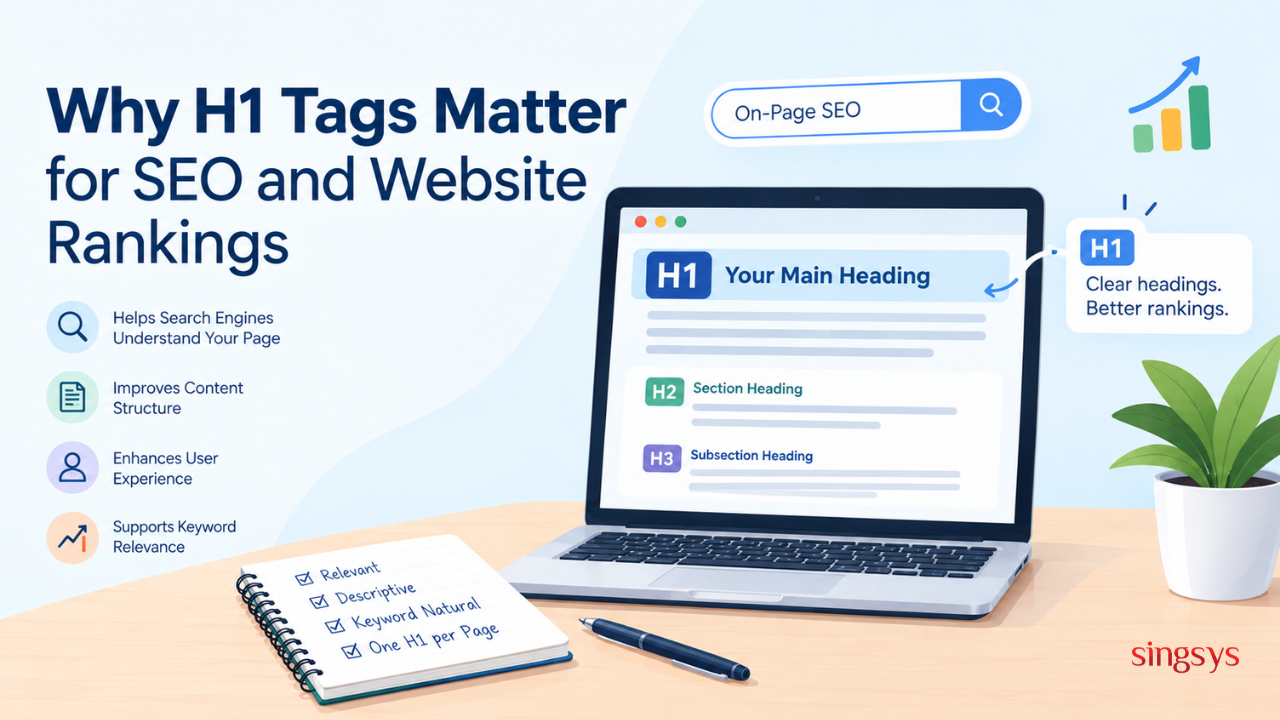
An H1 establishes a clear starting point for the content. Supporting H2 and H3 headings can then divide the information into logical sections.
For example:
H1: Digital Marketing Strategy for Small Businesses H2: Why Small Businesses Need Digital Marketing H2: Key Digital Marketing Channels H3: Search Engine Optimisation H3: Paid Advertising H3: Social Media Marketing
This structure makes long-form content easier to scan and understand.
3. They Improve User Experience
Most website visitors do not read every word on a page. They often scan headings first to decide whether the content is relevant.
A descriptive H1 immediately answers an important question:
“What is this page about?”
If the heading is vague or confusing, users may leave before exploring the rest of the content. A clear H1 helps set the right expectation from the beginning.
4. They Support Keyword Relevance
Using the primary keyword naturally in the H1 can help reinforce the topic of a webpage.
For example, if the target keyword is website SEO, an H1 such as:
Website SEO: A Practical Guide to Improving Search Visibility
is more useful than a generic heading such as:
Improve Your Online Presence
The keyword should fit naturally. There is no need to force an exact-match keyword into every H1.
5. They Create a Logical Heading Hierarchy
H1 tags are part of a broader heading structure.
A well-organised webpage generally uses:
H1 for the main page topic
H2 for major sections
H3 for supporting subsections
H4 and below when additional levels are genuinely needed
This hierarchy helps users navigate the content and creates a more logical document structure.
How Many H1 Tags Should a Page Have?
A common SEO recommendation is to use one clear primary H1 for a page.
Modern HTML allows more than one H1 in certain document structures, so having multiple H1 elements is not automatically an SEO problem. However, for most standard webpages, using one clearly defined H1 is a simple and effective approach.
The priority should be a logical page structure rather than following an arbitrary numerical rule.
H1 Tag Best Practices for SEO
A strong H1 should be useful to the reader first. Keep these practices in mind:
Keep It Clear and Descriptive
Visitors should understand the page topic immediately.
Every important page should have a heading that reflects its own purpose. This can help avoid confusion between similar pages and supports clearer site architecture.
Common H1 Mistakes to Avoid
Even technically simple elements can be poorly implemented. Some common mistakes include:
Using a generic H1: Headings such as “Welcome”, “Home” or “Learn More” provide little information about the page.
Missing the H1: A page without a clear primary heading can have a weaker content structure.
Using multiple unrelated H1s: Several prominent headings covering different topics can make the page purpose unclear.
Over-optimising the H1: Adding too many keywords can make the heading difficult to read.
Creating a misleading H1: The heading should match the actual content instead of promising something the page does not provide.
Do H1 Tags Directly Improve Rankings?
It is important to keep expectations realistic.
An H1 tag is not a magic ranking factor. Simply adding a keyword to an H1 does not guarantee higher rankings.
Search engines evaluate many factors when determining which pages should appear for a query. Content quality, relevance, technical performance, links, user experience and many other signals can influence search visibility.
The real value of H1 tag optimisation is that it contributes to a clear, well-structured and relevant webpage.
Final Thoughts
H1 tags may look like a small part of website optimisation, but they play an important role in organising content and communicating a page’s main topic.
A well-written H1 can help visitors understand your page quickly, support a logical content hierarchy and reinforce topical relevance. When combined with strong content and broader website SEO practices, it becomes part of a solid on-page optimisation strategy.
Instead of treating H1 tags as a quick ranking trick, think of them as the headline that introduces your page to both users and search engines. Keep them clear, relevant and natural, and make sure they accurately represent the content that follows.
Tanu Vishwakarma, a seasoned social media marketer, possesses a passion for promoting businesses online. She specialises in crafting creative strategies to captivate potential customers. Her dedication to staying updated on industry trends ensures that her methods are always effective. Tanu thrives on helping businesses shine in the digital realm.
Allocating a B2B marketing budget is an important decision for businesses looking to generate qualified leads, increase brand visibility, and build a consistent sales pipeline. With multiple digital marketing channels […]
For years, Google Ads has been one of the first platforms marketers think about when they hear “paid search.” It remains a powerful channel, but the paid search landscape is […]
Noida has quickly become one of the major business and technology hubs in the Delhi-NCR region. With startups, eCommerce brands, IT companies, real estate businesses, healthcare providers and established enterprises […]