The solar energy industry is growing rapidly as businesses, homeowners and organisations increasingly invest in renewable energy. But while solar technology continues to evolve, many solar companies still rely on spreadsheets, disconnected software and manual processes to manage their sales, installations and customer relationships.
This is where a dedicated Solar CRM Development Company in India can make a real difference.
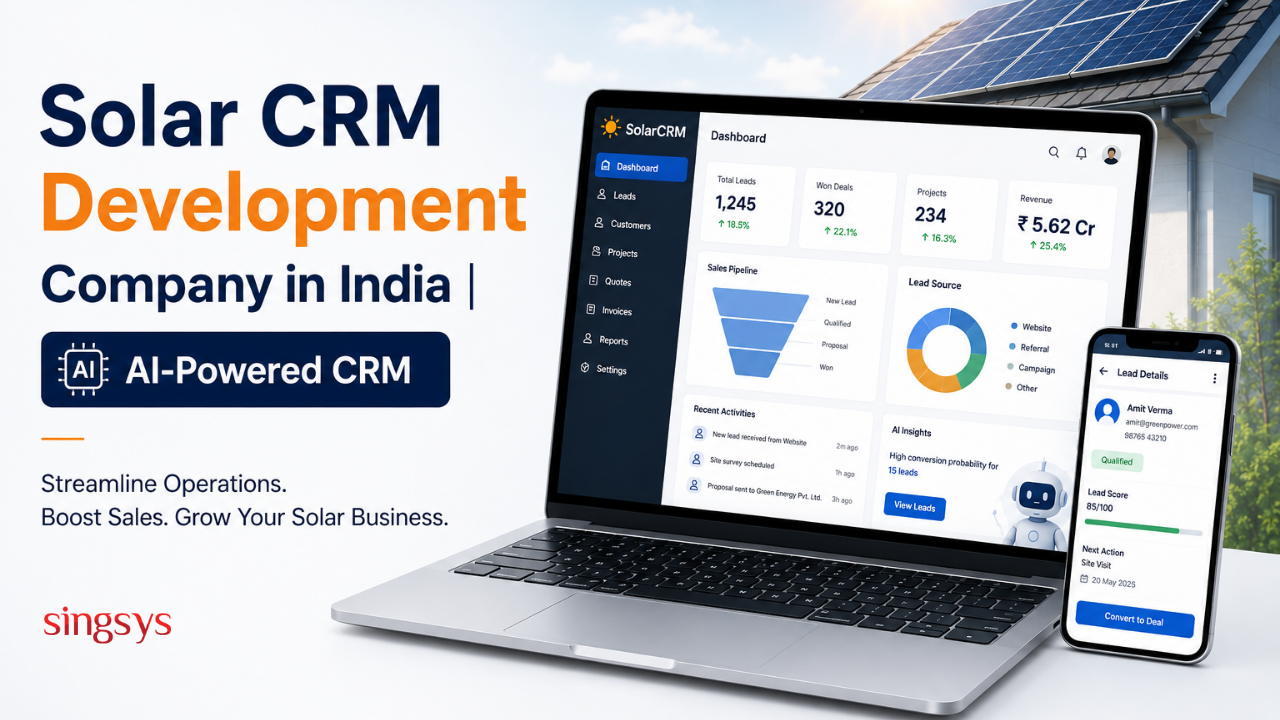
A solar CRM is more than a traditional customer relationship management system. It is designed around the specific workflow of solar businesses—from capturing leads and preparing quotations to managing site surveys, installations, payments and after-sales service.
With AI now becoming an important part of business automation, companies can take this a step further by adopting an AI-Powered Solar CRM Development Company to build intelligent systems that reduce repetitive work and help teams make better decisions.
Solar CRM software is a specialised customer relationship management platform designed for solar installers, EPC companies, distributors, manufacturers and renewable energy businesses.
A well-designed solar CRM brings different parts of the customer journey into one system.
For example:
Lead Generation → Lead Qualification → Site Survey → System Design → Quotation → Follow-Up → Installation → Payment → Maintenance
Instead of managing each stage separately, sales, technical and operations teams can work from the same platform.
A solar CRM can help businesses organise customer information, monitor sales pipelines, automate follow-ups and keep track of projects after the sale.
Why Do Solar Companies Need a Dedicated CRM?
Solar sales and installation processes are different from many conventional businesses.
A customer may first request information, followed by a consultation, site inspection, energy assessment, system design and quotation. Once the customer approves the proposal, the company still needs to coordinate procurement, installation, inspections, documentation and maintenance.
Managing this process manually can quickly become complicated.
A dedicated CRM can help solve common challenges such as:
Lost or unqualified leads
Delayed sales follow-ups
Manual quotation preparation
Scattered customer information
Poor coordination between sales and installation teams
Difficulty tracking project progress
Limited visibility into sales performance
Missed maintenance opportunities
By bringing these processes together, businesses can create a more structured and predictable workflow.
Key Features of Custom Solar CRM Software
Every solar business has different processes, so Custom Solar CRM Software can be configured around specific operational requirements.
1. Lead Management
The CRM can capture leads from websites, social media, advertising campaigns, referral programmes and other sources.
Sales teams can then categorise leads based on factors such as:
Location
Property type
Energy requirements
System size
Budget
Lead source
Buying stage
This makes it easier for sales representatives to focus on high-potential opportunities.
2. Sales Pipeline Management
A visual sales pipeline allows teams to see exactly where each opportunity stands.
Typical stages may include:
New Lead → Contacted → Qualified → Site Survey → Proposal Sent → Negotiation → Won/Lost
Managers can identify bottlenecks and understand how effectively leads are moving through the funnel.
3. Solar Site Survey Management
Site surveys are an important part of solar installation.
A CRM can allow field teams to record information such as:
Property details
Roof type
Roof dimensions
Electricity consumption
Shading information
Photos
Installation requirements
Customer preferences
Field staff can enter information directly through a mobile application instead of relying on paper forms.
4. Quotation and Proposal Management
Creating accurate proposals manually can take considerable time.
A solar CRM can help generate professional quotations using customer information, selected equipment, system capacity, pricing and installation details.
Templates can also help maintain consistency across proposals.
5. Customer Communication
Following up at the right time can have a major impact on solar sales.
CRM automation can help send:
Follow-up reminders
Email notifications
SMS messages
Appointment reminders
Proposal notifications
Installation updates
Payment reminders
This reduces the chances of promising leads being forgotten.
How AI Can Transform Solar CRM
Traditional CRM software stores information and helps teams manage workflows.
An AI-powered CRM can go a step further by analysing information and assisting employees with decisions.
An AI-Powered Solar CRM Development Company can integrate artificial intelligence into different parts of the CRM ecosystem.
AI Lead Scoring
AI can analyse historical customer data and identify leads that are more likely to convert.
Sales representatives can then prioritise their time accordingly.
AI Sales Forecasting
AI can analyse previous sales, seasonal trends, locations and pipeline activity to help businesses forecast potential revenue.
AI-Powered Follow-Ups
The system can identify when a customer is likely to need a follow-up and recommend the next action to the sales representative.
Intelligent Customer Support
An AI assistant can answer common questions about solar systems, installation timelines, maintenance and general product information.
More complex queries can automatically be transferred to human representatives.
Automated Data Entry
AI can help extract useful information from forms, emails, documents and customer conversations, reducing repetitive data-entry work.
Predictive Maintenance
After installation, AI can analyse relevant system information and help identify potential maintenance requirements before they become larger problems, where suitable data and integrations are available.
Solar CRM for Sales and Installation Teams
One of the biggest benefits of a dedicated CRM is improved collaboration.
Sales representatives can see customer information and proposal history.
Technical teams can access site survey details and installation requirements.
Project managers can monitor installation progress.
Customer support teams can access previous interactions and service records.
This creates a connected workflow rather than separate teams working from different spreadsheets or applications.
Mobile Solar CRM for Field Teams
Solar businesses often have employees working away from the office.
A mobile CRM can allow field representatives and technicians to access important information while visiting customer locations.
Useful mobile features can include:
Customer profiles
Lead updates
GPS and location information
Site survey forms
Photo uploads
Appointment schedules
Digital signatures
Task management
Installation updates
Offline data capture
This can reduce paperwork and help field teams update information immediately after completing a task.
Solar CRM Integrations
A modern solar CRM should not operate in isolation.
Depending on the business model, it may need to integrate with:
Website lead forms
Marketing platforms
Email and SMS services
Accounting software
Payment gateways
ERP systems
Inventory management systems
Solar design tools
Mapping and location services
Customer support platforms
Business analytics tools
These integrations can help create a connected technology ecosystem for the solar business.
Benefits of Custom Solar CRM Software
Off-the-shelf CRM platforms can be useful, but they may not always match the specific requirements of solar businesses.
Custom development allows companies to build functionality around their actual workflows.
Better Lead Management
All leads can be organised in one central system.
Faster Sales Processes
Automated workflows can reduce repetitive administrative tasks.
Improved Customer Experience
Customers can receive faster responses, clearer updates and more organised communication.
Better Team Collaboration
Sales, technical and operations teams can access the information they need.
Actionable Business Insights
Dashboards can provide visibility into lead sources, conversions, revenue, project status and team performance.
Scalability
A custom system can evolve as the business expands into new regions, products or services.
How Much Does Solar CRM Development Cost?
The cost of developing a solar CRM depends heavily on its features and complexity.
Factors that can influence the development budget include:
Number of users
Web and mobile applications
CRM functionality
AI features
Third-party integrations
Site survey capabilities
Quotation automation
Reporting and analytics
Cloud infrastructure
Security requirements
Custom UI/UX
Maintenance and support
A basic CRM focused on lead and customer management will generally require less development effort than a comprehensive platform covering sales, field operations, project management, inventory, AI and customer service.
For this reason, businesses should define an MVP before developing advanced functionality.
How to Choose a Solar CRM Development Company in India
Choosing the right technology partner is an important part of the project.
The development team should understand the solar sales and installation lifecycle.
Customisation Capability
The CRM should be designed around your processes rather than forcing your business to adapt to a generic system.
AI Expertise
If AI is part of the roadmap, evaluate the company’s experience with AI integration, automation, predictive analytics and intelligent assistants.
Integration Experience
Your CRM may need to communicate with existing business applications and third-party services.
Security
Customer, financial and business information should be protected through appropriate authentication, access controls, encryption and monitoring.
Scalability
The system should be capable of supporting increasing users, customers, projects and data volumes.
Why Businesses Are Moving Towards AI-Powered Solar CRM
The next generation of CRM platforms will focus less on simply storing customer information and more on helping businesses act on it.
Imagine a sales manager opening the CRM in the morning and seeing:
Which leads require immediate attention
Which proposals are likely to convert
Which sales representatives need support
Which customers have not been contacted recently
Which projects may be delayed
Which service requests require attention
Instead of searching through spreadsheets and reports, teams can receive meaningful insights directly from the system.
This is one of the strongest reasons to consider an AI-Powered Solar CRM Development Company when planning a new CRM platform.
Final Thoughts
Solar businesses operate across multiple stages—from lead generation and site surveys to installation, payment collection and long-term customer service. Managing these activities efficiently becomes increasingly difficult as the business grows.
A dedicated solar CRM can bring these processes together, while AI can make the platform more intelligent by helping teams analyse data, automate repetitive tasks and prioritise important activities.
Whether you need a simple lead management platform or a comprehensive system covering sales, field operations, project management and AI automation, Custom Solar CRM Software can be designed around your business requirements.
Partnering with an experienced Solar CRM Development Company in India can help you build a scalable platform that supports your current operations while leaving room for future growth and AI-powered innovation.
Tanu Vishwakarma, a seasoned social media marketer, possesses a passion for promoting businesses online. She specialises in crafting creative strategies to captivate potential customers. Her dedication to staying updated on industry trends ensures that her methods are always effective. Tanu thrives on helping businesses shine in the digital realm.
Singapore has built a strong reputation as a technology and healthcare hub in Asia. From telemedicine and patient engagement platforms to hospital management systems, AI-powered healthcare solutions and digital health […]
In today’s competitive digital landscape, users expect mobile applications to perform flawlessly across multiple devices and operating systems. Whether an app is built using React Native, Flutter, Xamarin, or another […]
The solar energy industry is growing rapidly across India and around the world. As more businesses and homeowners move towards renewable energy solutions, solar companies are facing increasing demand for […]