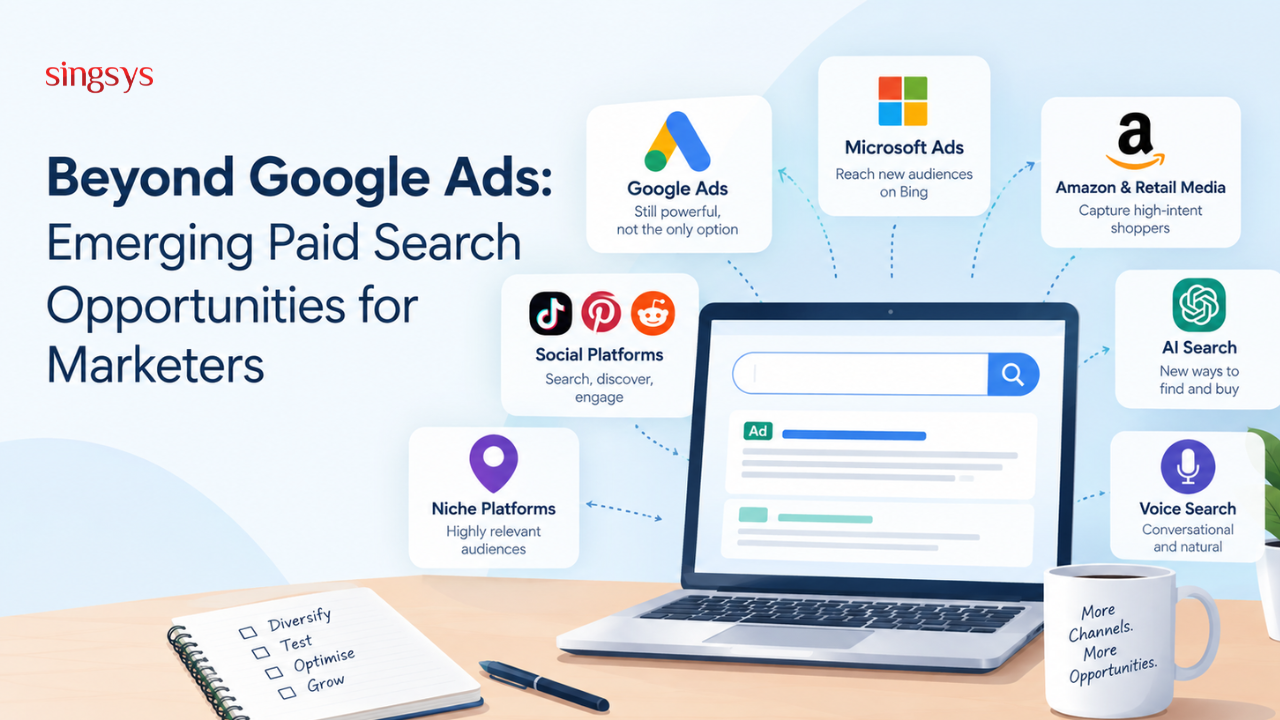
For years, Google Ads has been one of the first platforms marketers think about when they hear “paid search.” It remains a powerful channel, but the paid search landscape is changing quickly.
People are no longer searching only on traditional search engines. They are discovering products through marketplaces, social platforms, AI-powered search tools, retail websites and specialised platforms. At the same time, changing user behaviour and rising advertising costs are encouraging marketers to diversify their paid search strategies.
For businesses looking to reach customers at different stages of the buying journey, this creates an exciting opportunity: paid search is becoming bigger than Google Ads.
Google still attracts an enormous amount of search activity, but relying entirely on one advertising platform can limit growth.
Competition for high-value keywords can make Google Ads expensive, particularly in industries such as finance, software, legal services and e-commerce. Marketers also have less control over how search behaviour is changing as users increasingly turn to marketplaces, social platforms and AI tools for answers.
Diversifying paid search can help businesses:
Reach audiences on different platforms
Discover less competitive advertising opportunities
Reduce dependency on a single channel
Capture customers closer to the point of purchase
Test new audiences and search behaviours
Improve overall paid media performance
The goal isn’t to abandon Google Ads. Instead, it is to build a more diverse search advertising strategy.
1. Microsoft Ads: An Often-Overlooked Opportunity
Microsoft Ads remains one of the most established alternatives to Google Ads.
Its search advertising network can help marketers reach users across Bing and Microsoft’s broader ecosystem. For businesses targeting professionals, older audiences or desktop users, Microsoft Ads can be particularly worth testing.
Another advantage is that campaigns can often be imported from Google Ads, making experimentation easier for advertisers already familiar with Google’s platform.
For marketers, the key is not simply copying a Google campaign and expecting identical results. Search behaviour, audience demographics and conversion rates can vary between platforms, so campaigns should be monitored and optimised independently.
2. Amazon and Retail Media Search
For e-commerce brands, search does not necessarily begin on Google.
Many shoppers go directly to Amazon or other online marketplaces when they already know they want to purchase something. This makes retail media advertising particularly valuable.
Sponsored product listings and other marketplace advertising formats allow brands to appear when shoppers are actively looking for products.
The biggest advantage is intent. Someone searching for a specific product on a marketplace may be much closer to making a purchase than someone conducting a general informational search.
Retail media can therefore complement traditional PPC advertising by capturing consumers further down the purchase funnel.
3. Paid Search on Social Platforms
Platforms such as TikTok, Pinterest and Reddit are also becoming important discovery environments.
Although these platforms don’t work exactly like traditional search engines, users increasingly search for recommendations, products, tutorials, reviews and ideas within social platforms.
For example, a user might search for:
“Best skincare routine”
“Small bedroom ideas”
“Running shoes for beginners”
“Best restaurants in Singapore”
This creates opportunities for marketers to combine search intent with social discovery.
Brands should pay attention to how their target customers use each platform rather than treating every channel as another version of Google.
4. AI Search Is Creating a New Advertising Landscape
One of the most significant developments in search marketing is the rise of AI-powered search.
Consumers are increasingly using AI tools to research products, compare services, find recommendations and answer complex questions. This is changing how information is discovered online.
For marketers, this raises an important question: How will paid advertising work when users receive an AI-generated answer instead of a traditional list of search results?
Advertising opportunities around AI search are still developing, but marketers should already be paying attention to this space.
The future may involve a combination of sponsored recommendations, commercial placements, product discovery and other advertising formats integrated into AI-driven experiences.
5. Search Advertising on Niche Platforms
Not every search opportunity exists on a major platform.
Specialised websites and industry-specific platforms can offer highly relevant audiences. For example, travel businesses may explore travel marketplaces, while B2B companies could consider professional or industry-specific platforms.
These environments may have smaller audiences than Google, but they can offer something equally valuable: high relevance.
When users search within a specialised platform, they often have a specific need or interest. That can make niche paid search particularly effective for businesses serving well-defined audiences.
6. Voice Search and Conversational Discovery
Voice search has also changed how people interact with search technology.
Instead of typing short phrases such as “Italian restaurant Singapore,” users may ask complete questions like, “Where can I find a good Italian restaurant near me?”
As conversational search continues to develop, marketers need to think beyond traditional keyword matching.
Understanding natural-language queries, user intent and longer conversational searches can help businesses prepare for the next generation of search advertising.
7. First-Party Data Will Become More Important
As privacy expectations and tracking restrictions continue to evolve, first-party data is becoming increasingly valuable.
Businesses should focus on building their own audiences through:
Website interactions
Customer databases
Purchases
Newsletter subscriptions
Loyalty programmes
CRM platforms
Combining first-party data with paid search campaigns can help marketers create more relevant audiences and measure customer journeys more effectively.
It also reduces dependence on third-party signals and gives businesses greater control over their marketing data.
How Should Marketers Approach Emerging Paid Search Channels?
The biggest mistake would be trying every new platform at once.
Instead, start with your audience.
Ask:
Where does my target customer search?
Then consider their intent. Are they researching, comparing products or ready to purchase?
From there, select one or two emerging channels that closely match the customer journey. Set clear KPIs and run controlled tests before increasing investment.
A simple approach could be:
Research → Test → Measure → Optimise → Scale
This makes it easier to identify which channels actually generate business results rather than simply producing clicks and impressions.
The Future of Paid Search Is More Diverse
Google Ads isn’t disappearing. It will continue to be an important part of digital advertising for many businesses. However, the definition of “search” is expanding.
Search now happens across marketplaces, social networks, AI tools, niche platforms and increasingly conversational interfaces.
For marketers, this means the opportunity isn’t simply finding another platform to replace Google Ads. It is about understanding where people search, what they are looking for and how they make decisions.
The brands that adapt early can build a more flexible paid search strategy, reach customers in new environments and potentially discover valuable opportunities before competition becomes intense.
The future of paid search isn’t about choosing Google or something else. It’s about being present wherever your customers are searching.
Tanu Vishwakarma, a seasoned social media marketer, possesses a passion for promoting businesses online. She specialises in crafting creative strategies to captivate potential customers. Her dedication to staying updated on industry trends ensures that her methods are always effective. Tanu thrives on helping businesses shine in the digital realm.
Allocating a B2B marketing budget is an important decision for businesses looking to generate qualified leads, increase brand visibility, and build a consistent sales pipeline. With multiple digital marketing channels […]
When optimising a website for search engines, many businesses focus on keywords, backlinks, page speed and meta descriptions. But there is another simple element that deserves attention: the H1 tag. […]
Noida has quickly become one of the major business and technology hubs in the Delhi-NCR region. With startups, eCommerce brands, IT companies, real estate businesses, healthcare providers and established enterprises […]