Artificial intelligence has changed how people create, consume, and share information. From writing blog posts and business reports to generating news summaries and answering everyday questions, AI-generated content is now part of countless digital workflows.
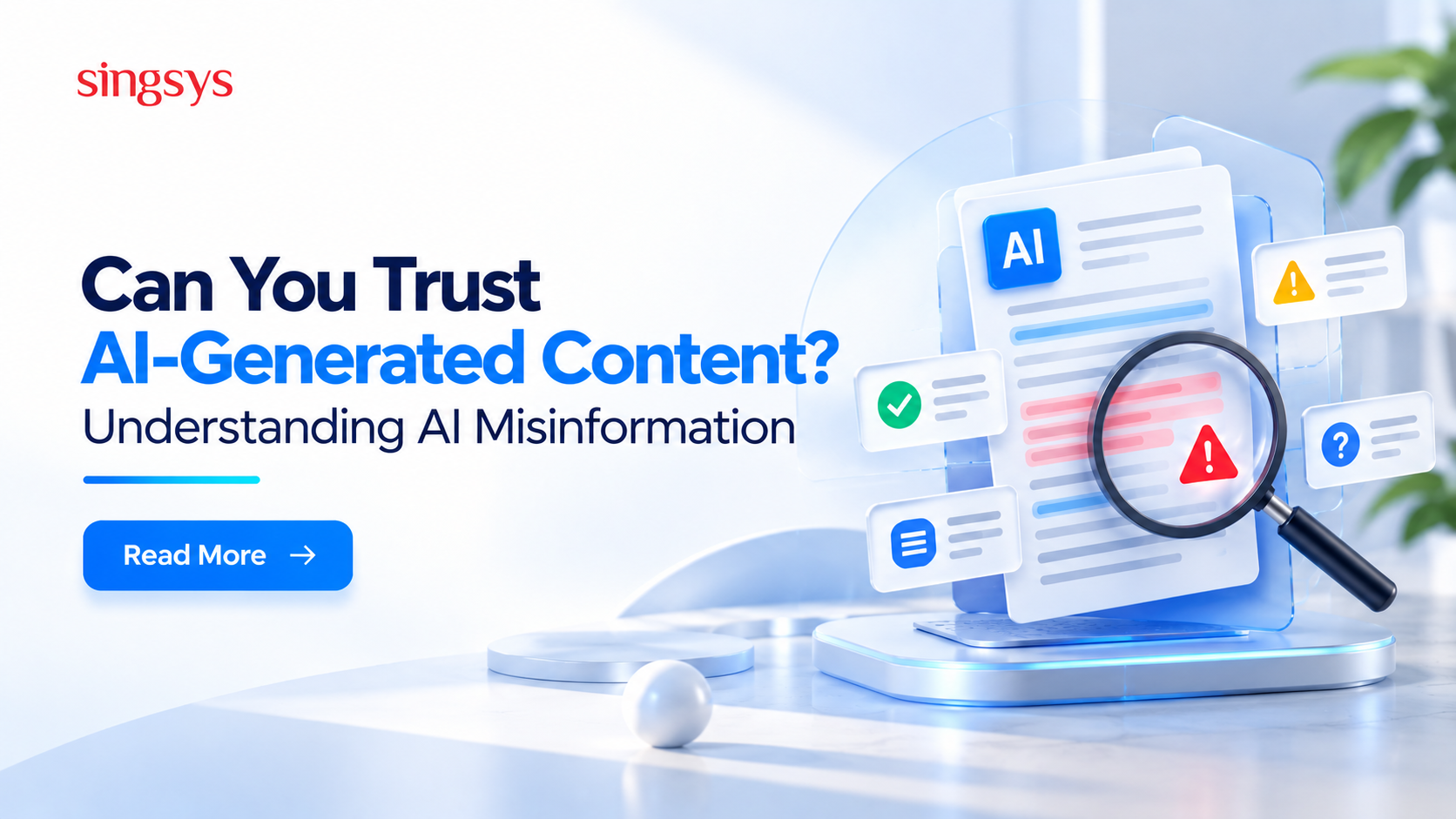
But an important question remains: Can you trust AI-generated content?
The answer is not a simple yes or no. AI can produce useful, well-structured, and highly accurate information, but it can also generate incorrect facts, outdated information, misleading claims, or completely fabricated details. This phenomenon is often associated with AI misinformation and AI hallucinations.
Understanding why these errors happen—and knowing how to identify and verify them—is essential for businesses, marketers, content creators, and everyday users.
AI-generated content refers to text, images, audio, video, or other material created with the help of artificial intelligence systems. Generative AI tools can analyze patterns from large amounts of training data and produce new content based on a user’s instructions.
For example, AI can help create:
Blog articles and website copy
Product descriptions
Social media posts
Business reports
Email drafts
Images and graphics
Video scripts
Research summaries
Software code
AI-generated content can significantly improve productivity. However, generating content quickly does not necessarily mean generating factually correct content.
Why Does AI Misinformation Happen?
One of the biggest misconceptions about generative AI is that it works like a search engine or traditional database. In reality, many AI systems generate responses by predicting what information is likely to come next based on patterns learned during training and the context of the conversation.
This means an AI model can sometimes produce a response that sounds convincing even when the underlying information is incorrect.
1. AI Can Hallucinate Information
An AI hallucination occurs when an AI system generates information that appears plausible but is inaccurate or entirely fabricated.
For example, an AI tool might provide a nonexistent research paper, attribute a quote to the wrong person, or invent statistics that sound credible.
The problem is that these mistakes are not always obvious. The response may have professional language, logical formatting, and confident explanations.
2. Information Can Become Outdated
AI systems may not always have access to the latest information. Depending on the tool and its configuration, its knowledge may have limitations around recent events, product updates, regulations, company changes, or emerging technologies.
This is particularly important when creating content around rapidly changing subjects such as AI, cybersecurity, finance, healthcare, or technology.
3. AI Can Misinterpret Context
AI-generated responses depend heavily on the instructions and context provided by the user. Ambiguous prompts can result in answers that misunderstand the intended question.
A small misunderstanding can affect the accuracy of an entire piece of content.
4. Training Data Can Contain Errors
AI models learn patterns from large datasets, and those datasets can contain inaccurate, biased, incomplete, or contradictory information.
As a result, AI can reproduce problematic information rather than independently determine whether every statement is true.
Can AI-Generated Content Be Trusted?
AI-generated content can be trusted as a starting point, but it should not automatically be treated as an authoritative source.
The level of trust should depend on the type of information being generated.
For brainstorming, drafting, summarizing familiar concepts, or creating content variations, AI can be extremely useful. However, content involving factual claims, statistics, legal requirements, medical information, financial decisions, scientific findings, or current events requires additional verification.
A useful approach is to treat AI as a content assistant rather than the final authority.
How to Identify Potential AI Misinformation
Recognizing potentially inaccurate AI content is an important digital skill. Watch for these warning signs:
Unusually Specific Claims
Be cautious when AI provides highly specific statistics, dates, studies, quotations, or references without credible sources.
Missing Sources
If an answer makes important factual claims but provides no way to verify them, investigate further.
Confident but Contradictory Statements
AI can present incorrect information with considerable confidence. A polished writing style does not guarantee factual accuracy.
Suspicious References
Check whether cited studies, websites, publications, or experts actually exist. AI can occasionally generate references that sound legitimate but cannot be found.
Outdated Information
For time-sensitive topics, verify information against current and authoritative sources rather than relying solely on an AI-generated response.
How to Fact-Check AI-Generated Content
Fact-checking should become a standard part of any professional AI content workflow.
1. Verify Important Claims
Identify statistics, dates, names, research findings, and other claims that could affect the credibility of your content. Verify them using reliable primary or authoritative sources.
2. Check Original Sources
Whenever possible, go beyond secondary summaries. For research-related content, check the original study or publication. For company information, use the organization’s official website.
3. Compare Multiple Reliable Sources
If information is important or potentially controversial, compare multiple reputable sources. Agreement between independent sources can provide greater confidence.
4. Add Human Review
Human expertise remains essential. An editor, subject-matter expert, or knowledgeable reviewer can identify contextual problems that an automated system may overlook.
5. Separate Facts From Opinions
Make sure AI-generated content clearly distinguishes factual information from interpretation, predictions, assumptions, or opinions.
AI Content and SEO: Does AI-Generated Content Hurt Rankings?
Using AI to assist with content creation does not automatically make content valuable or worthless from an SEO perspective. Search visibility depends heavily on whether the content is useful, relevant, trustworthy, original, and created to satisfy the user’s search intent.
The bigger risk is publishing low-quality AI-generated content without human oversight.
AI can help with research organization, outlines, content ideation, rewriting, and optimization. However, simply generating large volumes of generic articles can result in repetitive content that provides little value to readers.
For an effective SEO strategy, businesses should combine AI efficiency with human expertise, original insights, factual verification, and clear editorial standards.
Businesses can reduce the risks associated with AI misinformation by working with experienced AI specialists to implement AI development, generative AI, AI chatbot, and intelligent automation solutions with appropriate human oversight and validation. Explore Singsys AI solutions to learn how businesses can use AI to build smarter, more reliable digital workflows.
How Businesses Can Use AI Safely
Organizations can reduce the risks of AI misinformation by establishing a clear AI content workflow.
A practical process can include:
AI generation → Human review → Fact-checking → Expert validation → SEO optimization → Final publication
Businesses should also create guidelines defining what employees can use AI for and which types of information require mandatory human verification.
For example, AI may be suitable for generating initial marketing copy, but legal statements, financial claims, technical specifications, and sensitive business information should undergo appropriate expert review before publication.
The Future of Trust in AI-Generated Content
As generative AI becomes more sophisticated, distinguishing accurate information from AI misinformation will become increasingly important.
The goal should not be to avoid AI-generated content altogether. Instead, businesses and individuals need to develop better AI literacy—the ability to understand what AI can do, recognize its limitations, evaluate its outputs, and verify important information.
AI can make content creation faster and more efficient, but human judgment remains the critical layer of trust.
Build a Smarter Approach to AI Content
So, can you trust AI-generated content? Yes—but with the right level of caution.
AI is a powerful tool for research assistance, ideation, content creation, and productivity. However, its ability to produce convincing text does not mean every statement it generates is true. AI misinformation can emerge through hallucinations, outdated information, contextual misunderstandings, and unreliable source patterns.
The most effective approach is not AI versus humans, but AI plus human expertise. By fact-checking important claims, reviewing AI outputs, using authoritative sources, and maintaining strong editorial standards, businesses can benefit from AI while minimizing the risks of misinformation.
In an increasingly AI-driven digital environment, the ability to question, verify, and validate information may become just as important as the ability to generate it.
Artificial intelligence has changed the way software is built. From generating code and writing tests to debugging applications and analysing technical documentation, AI tools are becoming a regular part of […]
Artificial intelligence is no longer limited to futuristic products or experimental projects. Businesses across industries are now using AI to automate repetitive work, understand customer behaviour, improve decision-making and create […]
The way people interact with technology is changing. For years, typing, tapping, and clicking were the standard ways to use digital products. Today, voice is becoming a natural part of […]