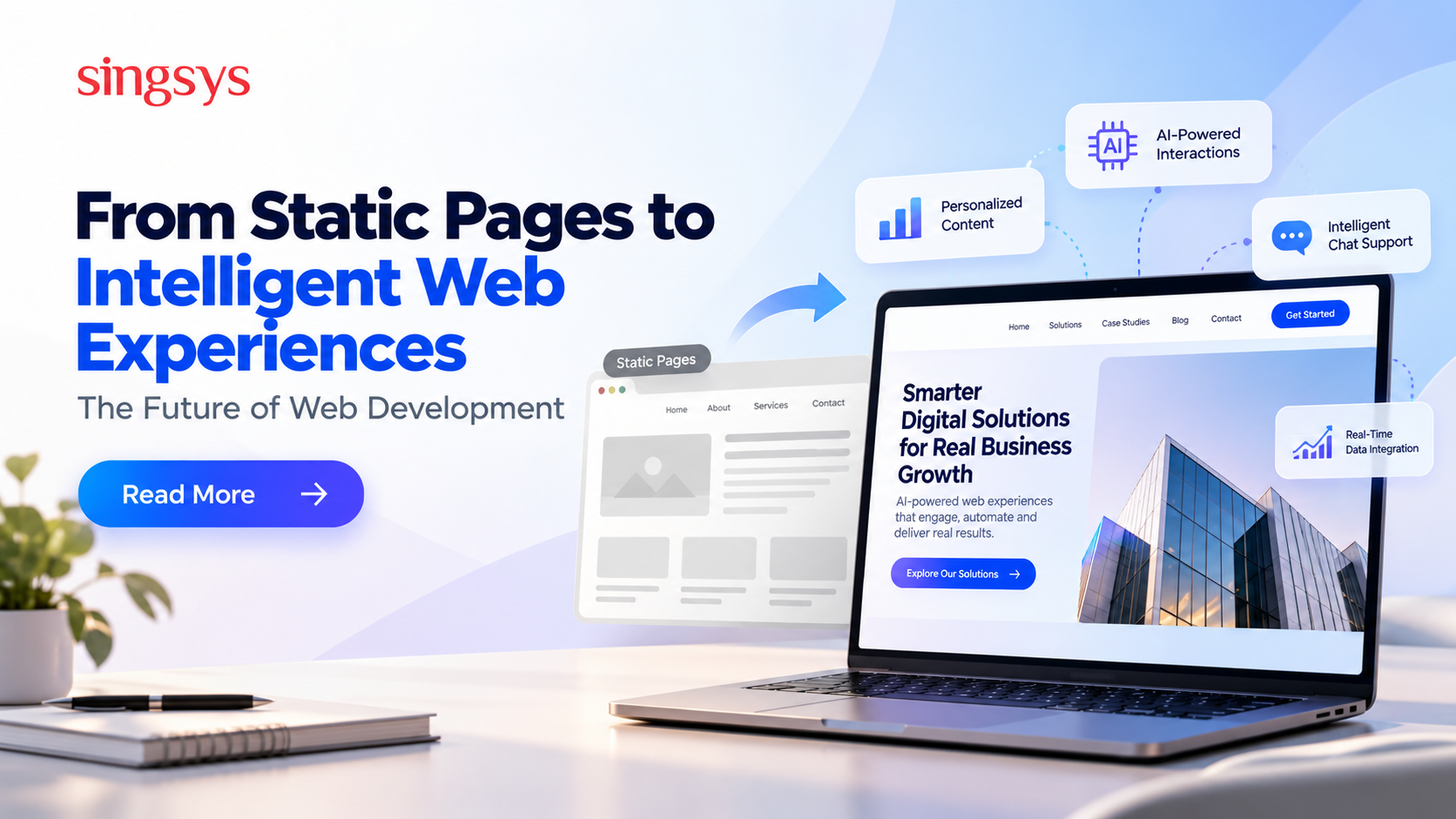
The internet has evolved significantly from the early days of simple web pages containing static text, images, and links. Today, users expect websites to be interactive, personalized, responsive, and capable of understanding their needs. Businesses are moving beyond traditional website layouts toward intelligent web experiences that combine artificial intelligence (AI), automation, real-time data, and user-focused design.
This transformation is changing how companies communicate with customers, deliver services, and build digital products. Instead of functioning merely as online information sources, modern websites can provide personalized recommendations, answer questions, automate tasks, and adapt to user behavior.
Understanding this shift is essential for businesses looking to strengthen their digital presence and remain competitive in an increasingly technology-driven marketplace.
What Are Static Websites, and Why Are They Evolving?
Static websites traditionally display predefined content that remains largely the same for every visitor. They are often built using HTML, CSS, and JavaScript, with each page presenting information such as company details, service descriptions, product information, or contact details.
These websites remain useful for portfolios, landing pages, informational resources, and projects that require straightforward functionality. They can also offer advantages in speed, simplicity, security, and hosting costs.
However, static websites may struggle to meet modern expectations when businesses need more advanced interactions, personalized content, dynamic data, or automated customer support.
For example, an online retailer may need to recommend products based on browsing behavior, while a service provider may want to help visitors identify suitable services through an interactive questionnaire.
This is where intelligent web experiences become valuable. They combine traditional web technologies with dynamic functionality to deliver more relevant and engaging interactions.
What Makes a Web Experience Intelligent?
An intelligent web experience uses data, automation, and advanced technologies to make a website more responsive to users and business requirements.
Rather than simply displaying information, it can help visitors discover relevant content, complete tasks, and access assistance more efficiently.
Several technologies contribute to this evolution.
1. Artificial Intelligence and Machine Learning
AI and machine learning can help websites analyze user interactions, identify patterns, and support personalized experiences.
For example, an e-commerce website can use recommendation systems to suggest relevant products. A service website can use AI-powered search to help visitors find information based on natural-language questions.
These capabilities make websites more useful by reducing the effort required to locate relevant information.
2. AI Chatbots and Conversational Interfaces
AI-powered chatbots allow visitors to interact with websites using natural language rather than navigating multiple pages.
They can answer frequently asked questions, guide users through services, collect preliminary lead information, and direct visitors to appropriate resources.
With carefully designed integrations, chatbots can also connect to customer relationship management systems, knowledge bases, and business applications.
Businesses exploring these capabilities can consider AI chatbot development services to create conversational experiences that support customer engagement and automate routine interactions.
3. Personalized Website Content
Personalization allows websites to display relevant content based on factors such as user preferences, browsing history, location, or previous interactions, where appropriate data and consent are available.
For example, a returning visitor might see recently viewed products, while a business website could highlight relevant case studies based on the visitor’s selected industry.
Effective personalization should improve usability rather than overwhelm users. Clear privacy practices and responsible data handling are essential.
4. Real-Time Data and Dynamic Interfaces
Modern websites increasingly depend on live information, including inventory availability, delivery updates, financial information, weather conditions, and operational dashboards.
APIs and backend systems allow websites to retrieve and display this information without requiring users to refresh entire pages or navigate to separate platforms.
Dynamic interfaces can make digital services more responsive and help users make decisions using current information.
Key Technologies Driving Intelligent Web Development
Building intelligent web experiences requires an appropriate combination of frontend, backend, data, and AI technologies.
Modern frontend frameworks: React, Angular, and Vue.js can support interactive interfaces and reusable components.
Backend technologies: Node.js, Python, PHP, and other server-side technologies can manage business logic, authentication, databases, and integrations.
AI and machine learning: AI APIs and machine learning frameworks can support conversational interfaces, recommendations, classification, and content processing.
Cloud infrastructure: Platforms such as AWS can provide scalable computing, storage, monitoring, and deployment services.
API integration: APIs connect websites with payment gateways, CRM systems, analytics platforms, AI models, and external data providers.
Data analytics: Analytics tools help businesses understand user journeys, identify friction points, and measure whether intelligent features improve business outcomes.
The right technology stack depends on the project’s complexity, existing infrastructure, performance requirements, budget, and long-term maintenance needs.
Benefits of Moving Beyond Static Web Pages
The transition toward intelligent web experiences offers several advantages for businesses.
Improved User Engagement
Interactive features, personalized recommendations, and conversational interfaces can make websites more engaging and easier to navigate.
Better Customer Support
AI chatbots and automated workflows can help answer common questions, guide users, and reduce repetitive support tasks.
More Relevant Customer Journeys
Personalized content and intelligent search can help users find the information or services that best match their needs.
Greater Operational Efficiency
Automation can reduce manual work in areas such as lead qualification, information retrieval, appointment scheduling, and routine data processing.
Data-Driven Improvements
Analytics and user feedback can help businesses identify what works, improve underperforming pages, and make more informed product decisions.
However, these benefits are not automatic. Intelligent features should solve genuine user problems and be evaluated against measurable goals such as engagement, task completion, lead quality, and customer satisfaction.
How Businesses Can Transform Static Websites into Intelligent Experiences
Businesses do not necessarily need to rebuild their entire websites to introduce intelligent functionality. A phased approach can help manage investment and minimize disruption.
Step 1: Evaluate the Existing Website
Review website performance, navigation, accessibility, user journeys, and conversion rates. Identify areas where visitors experience friction or struggle to find information.
Step 2: Identify High-Value Opportunities
Prioritize features that address clear business needs. These might include AI-powered search, personalized recommendations, automated lead capture, interactive service selectors, or chatbot integration.
Step 3: Choose the Right Architecture
Determine whether the existing website can support new features through APIs and modular integrations or whether a larger redesign is necessary.
Step 4: Develop and Integrate Features
Implement the selected functionality while maintaining website performance, usability, security, and accessibility.
Businesses planning a broader transformation can explore web application development services to build interactive platforms, intelligent interfaces, and custom digital solutions tailored to their operational needs.
Step 5: Test and Optimize
Measure performance using relevant indicators, such as task completion rates, engagement, lead conversions, response accuracy, and page speed. Use the results to refine the experience.
Challenges to Consider When Building Intelligent Websites
Despite their potential, intelligent web experiences introduce several considerations.
Data privacy: Businesses must handle personal information responsibly and comply with applicable privacy requirements.
Security: AI integrations, APIs, authentication systems, and connected databases require appropriate safeguards.
Performance: Excessive scripts, poorly optimized AI requests, and complex interfaces can slow down websites.
AI accuracy: AI-generated answers may be incorrect or incomplete. Important workflows should include validation, clear limitations, and human escalation where necessary.
Integration complexity: Connecting modern features with legacy platforms can require additional planning, testing, and maintenance.
Accessibility: Interactive components should remain usable for people with different abilities and assistive technologies.
Addressing these challenges early helps businesses build reliable experiences instead of adding advanced features without a sustainable technical foundation.
The Future of Intelligent Web Experiences
The next generation of websites will increasingly combine conversational interfaces, contextual recommendations, workflow automation, and real-time information.
AI agents may help users complete multi-step tasks, while more adaptive interfaces could simplify complex digital journeys. At the same time, privacy, transparency, security, and accessibility will remain essential to building user trust.
Businesses should focus on practical innovation rather than adopting every emerging technology. A well-designed intelligent website is one that helps users achieve their goals more efficiently while supporting clear business objectives.
Build the Next Generation of Web Experiences
The journey from static pages to intelligent web experiences represents a fundamental change in how businesses approach their digital presence. Websites are becoming more than online brochures; they are evolving into interactive platforms that support communication, personalization, automation, and digital service delivery.
By combining modern web development, AI-powered capabilities, thoughtful user experience design, and secure integrations, businesses can create digital experiences that respond more effectively to user needs.
The key is to start with real problems, select technologies that address them, and continuously improve through testing and feedback. With a clear strategy, businesses can transform their websites into smarter, more useful digital experiences that are ready for the future.
Choosing the right web development partner is not just about finding a company that can build a website. It is about finding a team that understands your business goals, communicates […]
The web development landscape continues to evolve rapidly, and businesses are constantly searching for ways to create faster, more efficient, and highly interactive web applications. One technology that has gained […]
A website is no longer just a digital brochure. It is your business’s most valuable asset. It works 24 hours a day, seven days a week. It answers customer questions, […]