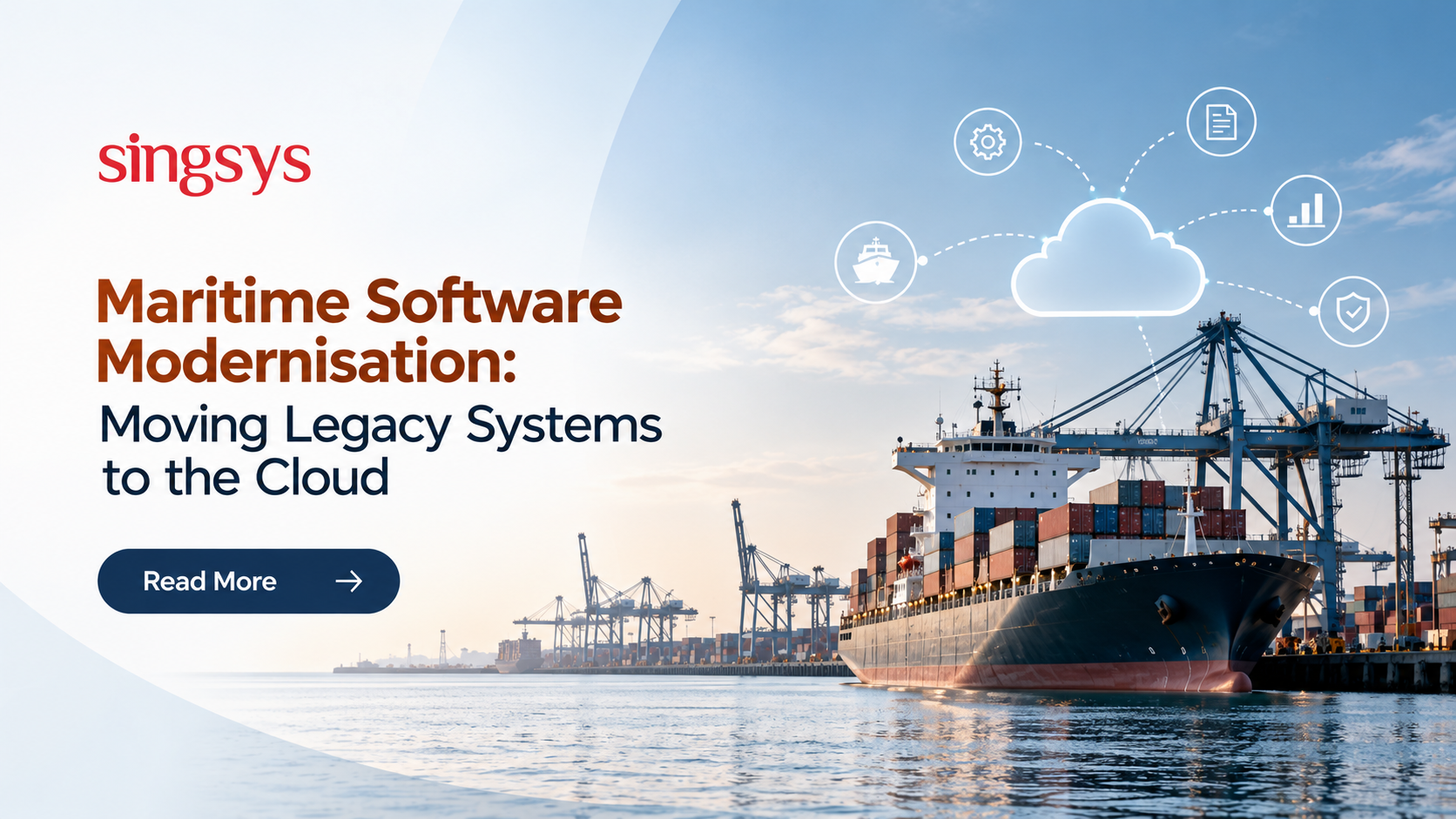
The maritime industry is undergoing a significant digital transformation as shipping companies, port operators, and logistics providers look for ways to improve operational efficiency, visibility, and security. However, many maritime businesses still depend on legacy software systems that were developed years ago. While these systems may support essential operations, they often struggle to meet the demands of modern shipping, real-time data exchange, and connected supply chains.
Maritime software modernisation offers a practical way to overcome these limitations. By migrating legacy applications to cloud-based environments, maritime organisations can improve scalability, strengthen data accessibility, and build a more resilient digital infrastructure.
In this blog, we explore why maritime software modernisation matters, how cloud migration works, and what businesses should consider when upgrading their existing systems.
Maritime software modernisation is the process of upgrading, replacing, or transforming existing software systems used in shipping, port management, vessel operations, cargo tracking, and maritime logistics.
Traditional maritime applications may run on on-premises servers, rely on outdated programming languages, or operate independently of other business systems. These limitations can make it difficult to exchange information across vessels, ports, suppliers, and headquarters.
Modernisation can involve moving applications to the cloud, redesigning outdated architecture, integrating APIs, automating manual workflows, and introducing advanced analytics.
Cloud migration is one of the most important parts of this process because it helps maritime businesses move beyond rigid infrastructure and adopt more flexible digital solutions.
Why Maritime Businesses Need to Move Legacy Systems to the Cloud
1. Overcoming Outdated Technology
Legacy maritime systems can be expensive to maintain, particularly when they depend on unsupported software, ageing hardware, or specialised technical expertise. Even small updates may require significant time and resources.
Moving suitable applications to a modern cloud environment helps organisations reduce infrastructure constraints and simplify maintenance. Businesses can also modernise applications gradually instead of replacing every system at once.
2. Improving Operational Visibility
Maritime operations generate data from multiple sources, including vessel management platforms, port systems, cargo tracking tools, and logistics applications. When these systems operate in separate environments, teams may struggle to access accurate information quickly.
Cloud-based platforms can bring data together and make it accessible to authorised teams across locations. This supports better coordination, more informed decision-making, and improved visibility into shipping operations.
3. Supporting Business Growth
As shipping volumes, routes, and customer requirements change, software must adapt accordingly. Traditional infrastructure may require organisations to purchase and configure additional hardware before handling increased workloads.
Cloud infrastructure offers flexible computing and storage capacity that can scale according to demand. This allows maritime businesses to support growth without continuously expanding their physical infrastructure.
4. Strengthening Business Continuity
System outages can disrupt cargo processing, vessel scheduling, documentation, and customer communication. Cloud platforms can support backup, disaster recovery, and redundancy strategies that help organisations recover from infrastructure failures.
However, resilience depends on proper architecture, tested recovery procedures, reliable connectivity, and clear operational responsibilities. Simply moving an application to the cloud does not automatically eliminate downtime.
Key Maritime Systems That Can Benefit from Cloud Migration
Several maritime applications can benefit from modern cloud infrastructure, depending on their technical requirements and operational importance.
Cargo tracking platforms: Improve shipment visibility and information sharing across supply chain participants.
Port management software: Support coordination of berth allocation, cargo handling, and terminal operations.
Fleet management applications: Enable authorised teams to access fleet information and monitor operational performance.
Maritime documentation systems: Digitise workflows for shipping documents, compliance records, and internal approvals.
Logistics and booking platforms: Connect shipment bookings, customer information, and transportation workflows.
Applications involving safety-critical vessel controls, specialised onboard equipment, or strict real-time requirements need additional assessment before migration. Some components may need to remain onboard or operate in a hybrid environment.
A Step-by-Step Approach to Maritime Cloud Migration
A structured migration strategy helps reduce operational risks and ensures that modernisation supports long-term business objectives.
Step 1: Assess Existing Systems
Start by documenting applications, databases, integrations, infrastructure dependencies, and business-critical workflows. Identify which systems are difficult to maintain, which require frequent updates, and which create data silos.
Classify applications according to business value, technical complexity, security requirements, and acceptable downtime.
Step 2: Choose the Right Cloud Strategy
Not every legacy application needs the same migration approach. Common options include:
Rehosting: Moving an application to cloud infrastructure with minimal changes.
Replatforming: Making selected adjustments to benefit from managed cloud services.
Refactoring: Redesigning parts of the application to improve scalability, maintainability, or performance.
Replacing: Adopting a modern solution when the existing system is no longer suitable.
The right choice depends on application architecture, budget, integration requirements, and future development plans.
Step 3: Modernise Data and Integrations
Maritime systems often exchange information with port authorities, shipping partners, freight forwarders, customs platforms, and enterprise applications.
During migration, teams should review data quality, database compatibility, API availability, and integration dependencies. Secure APIs and appropriate data standards can help different systems communicate more reliably.
Organisations should also establish data ownership, access permissions, validation rules, and processes for handling incomplete or inconsistent records.
Step 4: Prioritise Cybersecurity and Compliance
Cloud migration changes how systems are accessed, monitored, and protected. Maritime organisations should implement identity and access management, multifactor authentication, encryption, network segmentation, logging, and continuous security monitoring.
They should also assess applicable maritime cybersecurity requirements, data protection obligations, contractual commitments, and jurisdiction-specific regulations.
Security responsibilities must be clearly defined between the cloud provider, software team, and maritime operator.
Step 5: Test Before Full Deployment
Testing is essential before moving business-critical operations to a new environment. Validate application performance, data accuracy, system integrations, user permissions, backup procedures, and disaster recovery plans.
A pilot migration can help teams identify issues before they affect the wider organisation. Where necessary, phased deployment and parallel operation can provide additional safeguards.
Step 6: Monitor and Optimise
After migration, track application availability, response times, infrastructure costs, security events, and user feedback. Regular monitoring helps teams identify performance bottlenecks and unnecessary resource consumption.
Cloud modernisation should be treated as an ongoing process rather than a one-time infrastructure project.
Common Challenges in Maritime Software Modernisation
Although cloud migration offers significant benefits, maritime businesses must plan for several challenges.
Legacy compatibility: Older applications may depend on outdated databases, operating systems, or proprietary hardware.
Connectivity limitations: Vessels operating at sea may experience intermittent or expensive connectivity. Edge computing and offline-first functionality can help maintain essential operations when connections are unavailable.
Data migration risks: Incomplete records, inconsistent formats, and complex dependencies can affect data accuracy.
Operational disruption: Migrating critical systems without adequate testing can interrupt essential workflows.
Skills and change management: Employees may need training to adopt new interfaces, processes, and security practices.
Working with an experienced technology partner can help organisations assess these challenges, prioritise investments, and develop a migration roadmap aligned with business requirements.
How Custom Software Development Supports Maritime Modernisation
Off-the-shelf cloud products may not address every maritime organisation’s operational requirements. Businesses with specialised workflows can benefit from tailored applications, integrations, and modernisation services.
A technology partner offering custom software development services can help assess legacy architecture, modernise applications, build secure APIs, and integrate existing platforms with cloud infrastructure. Depending on the project, this may also include database modernisation, user interface improvements, automated testing, and ongoing maintenance.
The objective is not simply to move existing software to a different hosting environment. It is to create a maintainable digital foundation that supports evolving operational needs while preserving essential business functionality.
Building a Future-Ready Maritime Technology Infrastructure
Maritime software modernisation is becoming an important investment for organisations seeking greater operational visibility, scalable infrastructure, and improved digital resilience. Moving legacy systems to the cloud can help reduce infrastructure limitations, connect fragmented applications, and support more efficient workflows.
Success depends on choosing the right migration strategy, protecting sensitive data, planning for connectivity constraints, and testing critical operations thoroughly.
By adopting a phased, business-focused approach, maritime companies can modernise their technology without treating every legacy system as a replacement project. The result is a more adaptable software environment that can support the changing demands of global shipping and maritime logistics.
Singapore has built a strong reputation as a technology and healthcare hub in Asia. From telemedicine and patient engagement platforms to hospital management systems, AI-powered healthcare solutions and digital health […]
The solar energy industry is growing rapidly as businesses, homeowners and organisations increasingly invest in renewable energy. But while solar technology continues to evolve, many solar companies still rely on […]
In today’s competitive digital landscape, users expect mobile applications to perform flawlessly across multiple devices and operating systems. Whether an app is built using React Native, Flutter, Xamarin, or another […]