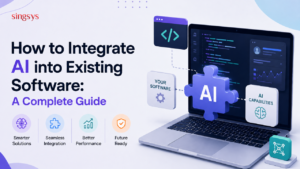
Artificial Intelligence is becoming an essential part of modern business operations. From automating customer support to analysing large datasets, businesses are adopting AI to improve productivity, reduce manual work, and deliver better customer experiences. However, when planning an AI-powered solution, one important decision often arises: should a business integrate existing AI technologies into its applications or invest in custom AI development?
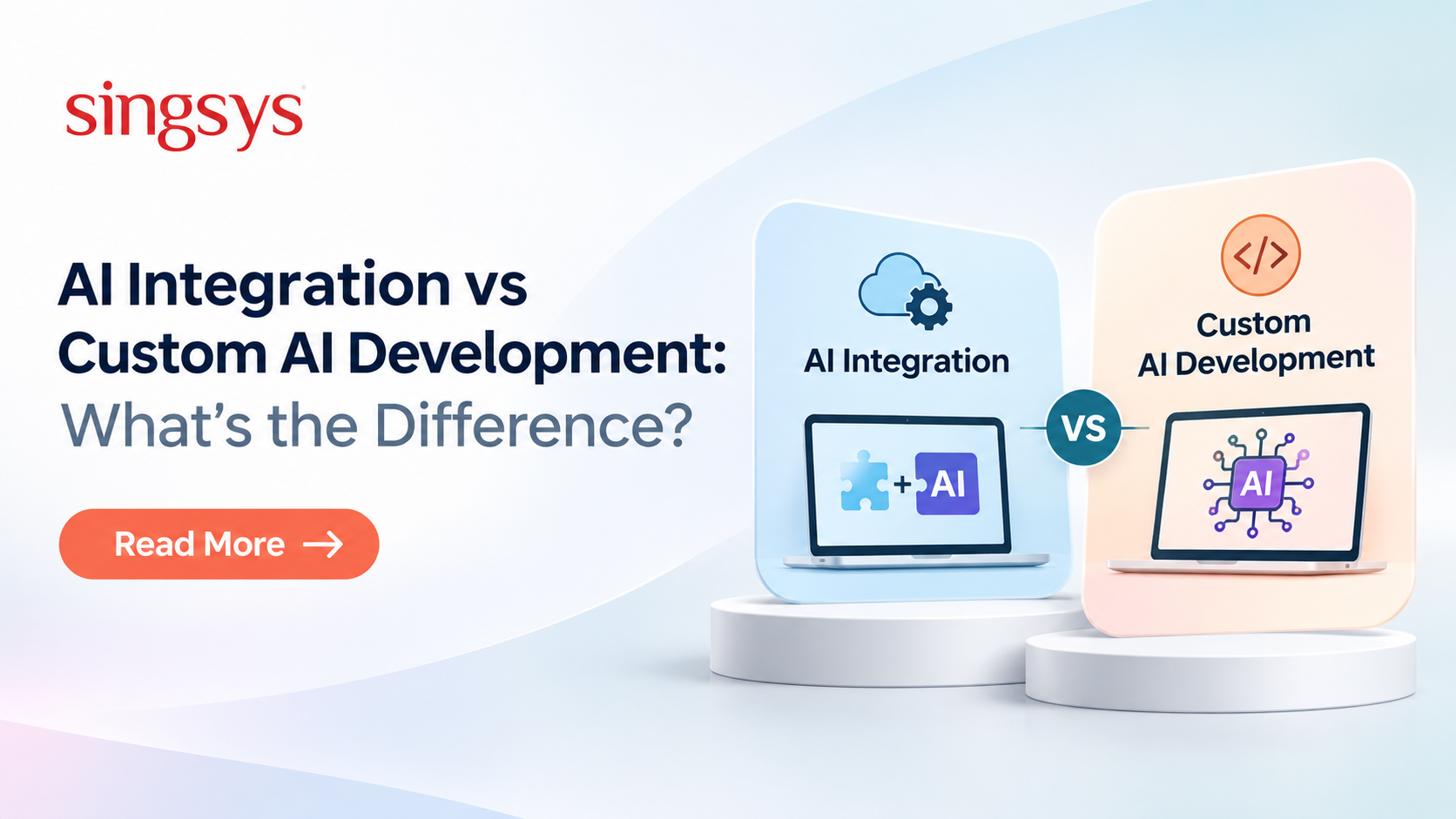
Although these approaches may seem similar, they serve different purposes. AI integration focuses on connecting existing AI models, tools, and platforms with business applications, while custom AI development involves building AI-powered solutions tailored to specific requirements.
Understanding the difference between AI integration vs custom AI development can help businesses choose an approach that aligns with their goals, technical capabilities, and long-term growth plans.
AI integration is the process of incorporating existing artificial intelligence technologies into an application, website, or business workflow. Instead of developing an AI model from scratch, businesses use ready-made AI services, APIs, and platforms to introduce intelligent capabilities into their existing systems.
For example, an e-commerce business can integrate an AI-powered recommendation engine to suggest products based on customer preferences. Similarly, a company can connect an AI chatbot to its website to answer common customer queries without requiring a dedicated support representative for every interaction.
Common applications of AI integration include:
AI chatbots: Automating customer support and handling frequently asked questions.
Predictive analytics: Using existing AI services to identify patterns and forecast business trends.
Content generation: Integrating generative AI tools to assist with writing, summarisation, and content creation.
Image recognition: Adding image classification or object detection capabilities through existing AI APIs.
Personalised recommendations: Delivering relevant products, services, or content based on user behaviour.
AI integration is particularly useful when businesses want to introduce intelligent functionality without investing heavily in developing and maintaining their own AI models.
2. What Is Custom AI Development?
Custom AI development involves designing and building AI-powered systems specifically for a business’s requirements. Unlike AI integration, which relies primarily on existing solutions, custom development may involve preparing datasets, selecting algorithms, training or fine-tuning models, and building application-specific AI workflows.
The objective is to create an intelligent solution that addresses a particular business challenge rather than relying entirely on general-purpose AI capabilities.
For instance, a manufacturing company may require an AI system that analyses equipment sensor data to predict machine failures. If available AI platforms cannot accurately interpret its specialised operational data, a custom model may provide better results.
Common applications of custom AI development include:
Predictive maintenance: Developing models that identify potential equipment failures using historical and real-time data.
Intelligent document processing: Building systems that extract and classify information from industry-specific documents.
Custom recommendation engines: Creating recommendation systems based on proprietary customer behaviour and business rules.
Computer vision solutions: Developing models for specialised image recognition, quality inspection, or object detection.
Industry-specific AI assistants: Building AI systems that understand business-specific terminology, workflows, and knowledge sources.
Custom AI development is suitable for businesses with specialised requirements, unique datasets, or complex workflows that cannot be addressed effectively through standard AI products.
3. AI Integration vs Custom AI Development: Key Differences
Although both approaches help businesses introduce artificial intelligence into their operations, they differ in implementation, flexibility, investment, and maintenance requirements.
Approach: AI integration connects existing AI tools, APIs, and models to applications or business workflows. Custom AI development involves building solutions specifically around an organisation’s technical and operational requirements.
Development Time: AI integration is generally faster because businesses can use existing AI technologies. Custom AI development usually requires additional time for planning, data preparation, development, testing, and deployment.
Initial Investment: Integrating existing AI services often involves a lower initial investment, although API usage and licensing fees may increase with usage. Custom AI development generally requires a higher upfront investment due to specialised development and infrastructure requirements.
Customisation: AI integration is limited by the functionality and configuration options offered by the selected platform. Custom AI development provides greater control over model behaviour, features, workflows, and application-specific requirements.
Data Requirements: AI integration can work with existing APIs and pre-trained models, depending on the application. Custom AI development may require relevant business datasets for model training, fine-tuning, or evaluation.
Scalability: Integrated AI solutions depend partly on the external provider’s infrastructure, usage limits, and pricing structure. Custom AI solutions can be designed around specific performance, infrastructure, and scalability requirements.
Maintenance: With AI integration, maintenance may depend on the external provider’s updates, API changes, and service availability. Custom AI solutions require ongoing maintenance of models, infrastructure, integrations, and application components.
Best Suited For: AI integration is ideal for businesses looking to introduce standard AI capabilities quickly. Custom AI development is more suitable for specialised requirements, unique datasets, and complex business challenges.
4. When Should Businesses Choose AI Integration?
AI integration is a practical option when businesses want to introduce established AI capabilities into existing applications without developing an entirely new system.
It works particularly well when the business requirement is clearly supported by available AI platforms.
Consider these scenarios:
You need faster implementation: If a business wants to introduce an AI chatbot, automated translation, or text summarisation, integrating an existing AI service can reduce development time.
Your requirements are relatively standard: Features such as speech-to-text conversion, language translation, and basic content generation are often available through established AI APIs.
You want to validate an idea: Businesses can integrate AI into an existing application to test its usefulness before committing to a larger development project.
You have limited development resources: Using existing AI platforms can reduce the effort required to build and maintain machine learning infrastructure.
However, businesses should evaluate API pricing, usage limits, data privacy, security, and vendor dependency before selecting an external AI provider.
5. When Is Custom AI Development the Better Choice?
Custom AI development becomes more valuable when standard AI services cannot meet specific operational or technical requirements.
Businesses may consider this approach in situations such as:
You work with specialised datasets: Industries such as healthcare, manufacturing, logistics, and finance often deal with data that requires specialised processing and interpretation.
Existing AI tools lack accuracy: If general-purpose models consistently produce unsuitable results for a particular workflow, custom training or fine-tuning may improve performance.
You need greater control: Businesses handling sensitive information or complex workflows may require more control over model behaviour, data processing, and deployment.
You want a unique competitive advantage: Custom AI capabilities can help businesses develop specialised products, automate complex operations, and deliver experiences that competitors cannot easily replicate.
However, custom AI development also involves responsibilities such as data preparation, model evaluation, infrastructure management, security, and ongoing optimisation.
6. Can Businesses Combine AI Integration and Custom AI Development?
AI integration and custom AI development do not have to be mutually exclusive. In fact, combining both approaches can be an effective strategy for businesses with evolving AI requirements.
For example, an organisation may initially integrate an existing generative AI API into its customer support platform. As its requirements become more specialised, it can introduce a custom knowledge retrieval system that connects the AI model to internal documents and business information.
Similarly, an e-commerce platform may use an existing AI service for product descriptions while developing a custom recommendation engine based on its proprietary customer and sales data.
A hybrid approach can help businesses balance implementation speed with customisation. It also allows them to introduce AI capabilities gradually instead of investing in a complex system from the beginning.
7. Factors to Consider Before Selecting an AI Development Approach
Before choosing between AI integration and custom AI development, businesses should evaluate their requirements beyond the initial implementation cost.
Some important considerations include:
Business objectives: Identify the specific problem AI needs to solve and the outcomes you expect.
Data availability: Determine whether existing datasets are sufficient for the intended AI application.
Technical complexity: Assess whether an established AI service can meet the required functionality and accuracy.
Budget and resources: Consider development expenses, API usage, infrastructure, and long-term maintenance.
Data security: Evaluate how information will be processed, stored, and shared with third-party AI providers.
Future scalability: Choose an approach that can accommodate changing business requirements and increasing usage.
Working with experienced AI development services providers can help businesses assess these factors, select suitable technologies, and build an implementation strategy aligned with their objectives.
The difference between AI integration and custom AI development comes down to how a business wants to use artificial intelligence.
AI integration offers a faster way to introduce established AI capabilities into existing applications, making it suitable for standard requirements and quicker implementation. Custom AI development, on the other hand, provides greater flexibility for specialised workflows, proprietary datasets, and unique business challenges.
Neither approach is universally better. The right decision depends on the problem being solved, available resources, data requirements, and long-term business goals.
For many organisations, the most effective strategy may involve starting with AI integration and gradually introducing custom AI capabilities as their needs evolve. By selecting the right approach, businesses can make AI adoption more practical, scalable, and valuable.
Online shopping has made purchasing products easier than ever, but convenience alone is no longer enough to satisfy modern consumers. Customers increasingly expect online stores to understand their preferences, recommend […]
Artificial intelligence has changed how people create, consume, and share information. From writing blog posts and business reports to generating news summaries and answering everyday questions, AI-generated content is now […]
Artificial intelligence has changed the way software is built. From generating code and writing tests to debugging applications and analysing technical documentation, AI tools are becoming a regular part of […]