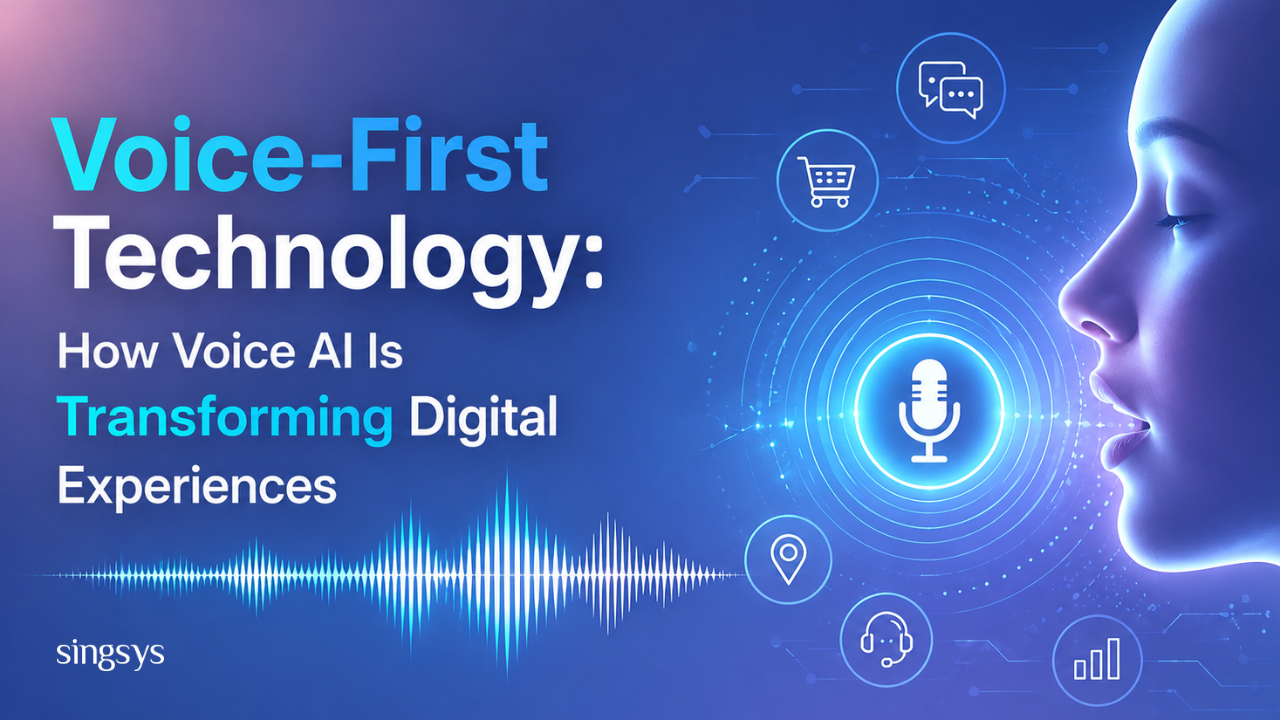
The way people interact with technology is changing. For years, typing, tapping, and clicking were the standard ways to use digital products. Today, voice is becoming a natural part of that experience. From asking a smartphone for directions to controlling smart home devices or speaking with an AI assistant, people are increasingly using their voices to get things done.
This shift is driving the rise of voice-first technology, where voice becomes a primary interface rather than simply an additional feature. With advances in artificial intelligence, natural language processing (NLP), and machine learning, voice-enabled systems are becoming faster, more accurate, and better at understanding human intent.
For businesses, this creates an opportunity to rethink how customers interact with websites, applications, devices, and digital services.
Voice-first technology refers to digital experiences designed around spoken communication. Instead of relying primarily on screens, menus, keyboards, or touch controls, users can communicate with a system using natural language.
Modern voice AI can do much more than recognise individual words. It can understand questions, interpret context, identify intent, respond conversationally, and sometimes complete actions on the user’s behalf.
For example, a customer could say:
“I need to reschedule my appointment for next Friday afternoon.”
A sophisticated voice-enabled application can understand the request, check availability, suggest suitable times, and confirm the new appointment.
This makes voice interaction feel less like operating software and more like having a conversation.
Why Is Voice AI Becoming So Important?
One of the biggest reasons behind the growth of voice AI is convenience. Speaking is often faster and more natural than typing, particularly when users are multitasking or accessing a service while on the move.
Voice technology can also make digital experiences more accessible. People who find traditional interfaces difficult to navigate can interact with applications through spoken commands.
Businesses are paying attention because voice can influence several parts of the customer journey, including:
Customer support
Search and information discovery
Online shopping
Appointment booking
Navigation
Banking and financial services
Smart home experiences
Healthcare applications
Internal business workflows
As AI models become more capable, these interactions are moving beyond simple commands towards contextual conversations.
How Voice AI Is Transforming Digital Experiences
1. More Natural Customer Interactions
Traditional digital interfaces require users to learn how a system works. They need to find the right button, navigate menus, or enter specific search terms.
Voice AI reduces this friction by allowing people to communicate naturally.
Instead of searching for a product through multiple filters, a customer could say:
“Show me lightweight running shoes under £100 that are suitable for beginners.”
The system can interpret multiple requirements and provide relevant results.
This conversational approach can make digital products feel more intuitive and personalised.
2. Smarter Customer Support
Customer service is one of the areas where voice AI can have a significant impact.
AI-powered voice assistants can answer common questions, help customers troubleshoot problems, check order information, and route complex requests to human agents.
Unlike basic automated phone systems that rely heavily on numbered menus, conversational voice AI can understand natural questions.
This can reduce waiting times while allowing human support teams to focus on more complicated customer issues.
3. Voice-Enabled Shopping Experiences
Voice commerce is another area with considerable potential.
Customers can use voice commands to search for products, compare options, check order status, and potentially complete purchases.
For example:
“Where is my order?”
or
“Add my usual coffee pods to the shopping cart.”
These simple interactions can make repeat purchases much easier.
For eCommerce businesses, the challenge will be ensuring that voice interfaces provide useful recommendations without making the buying experience confusing or overly conversational.
4. Greater Accessibility
Voice technology can help make digital services more inclusive.
Users with visual impairments, mobility limitations, or difficulties using conventional interfaces may benefit from voice-based navigation and interaction.
Voice-first design can allow users to perform tasks without depending entirely on a touchscreen or keyboard.
However, accessibility should not mean replacing traditional interfaces altogether. The strongest digital experiences will usually provide multiple ways to interact, allowing users to choose what works best for them.
5. Personalised Digital Experiences
AI can analyse context and user preferences to make voice interactions more relevant.
For example, a travel application could understand a request such as:
“Find me a family-friendly hotel near the beach for three nights.”
Instead of simply matching individual keywords, an intelligent system can interpret the broader intent and return relevant options.
Over time, voice AI can become more useful when it understands preferences, previous interactions, and context—while still respecting privacy and user consent.
Voice AI Is Moving Beyond Smart Speakers
When people think about voice technology, smart speakers and virtual assistants often come to mind. But voice AI is expanding far beyond these devices.
Today, businesses can integrate voice capabilities into:
Mobile applications
Websites
Automotive systems
Wearable devices
Smart appliances
Healthcare platforms
Banking applications
Enterprise software
Customer service platforms
This means voice is becoming an interaction layer that can work across different digital environments.
The future is not necessarily about replacing screens with voice. Instead, it is about creating multimodal experiences, where users can move naturally between voice, touch, text, visuals, and other interfaces.
The Role of AI Development Companies
Building an effective voice-first experience requires more than adding speech recognition to an existing application. Businesses need the right combination of AI models, conversational design, backend integration, security, and user experience.
An experienced AI development company can help organisations identify practical use cases and build voice-enabled solutions around their specific business requirements.
The development process may involve technologies such as:
Speech-to-text systems
Natural language processing
Large language models
Text-to-speech technology
Conversational AI
Machine learning
APIs and backend integrations
Authentication and security systems
The goal should not simply be to make an application “talk.” The goal is to make voice interaction genuinely useful.
Challenges Businesses Need to Consider
Despite its potential, voice-first technology comes with challenges.
Privacy is one of the biggest concerns. Voice systems may process sensitive conversations or personal information, so businesses need strong data protection practices.
Accuracy also matters. Accents, background noise, different languages, speech patterns, and unclear requests can affect recognition.
There is also the challenge of context. Understanding what someone says is only part of the problem. AI must also understand what the user means and what action should follow.
Finally, businesses need to consider when voice is actually useful. Not every task is easier through speech. Sometimes a visual interface remains faster and more convenient.
What Does the Future of Voice-First Technology Look Like?
Voice AI is likely to become increasingly integrated into everyday digital experiences. As AI systems improve their ability to understand context, emotions, intent, and natural conversation, voice interactions may become less robotic and more human-like.
We can expect to see more applications where users simply describe what they want rather than manually navigating complex interfaces.
The biggest opportunity for businesses is not to follow the voice trend blindly, but to identify where voice can remove friction from the customer journey.
Voice-first technology is ultimately about making technology easier to communicate with. As AI continues to evolve, speaking to software may become as ordinary as clicking a button or opening an app. Businesses that thoughtfully adopt voice AI today can position themselves for a more conversational, accessible, and intuitive digital future.
Tanu Vishwakarma, a seasoned social media marketer, possesses a passion for promoting businesses online. She specialises in crafting creative strategies to captivate potential customers. Her dedication to staying updated on industry trends ensures that her methods are always effective. Tanu thrives on helping businesses shine in the digital realm.
Artificial intelligence has changed how people create, consume, and share information. From writing blog posts and business reports to generating news summaries and answering everyday questions, AI-generated content is now […]
Artificial intelligence has changed the way software is built. From generating code and writing tests to debugging applications and analysing technical documentation, AI tools are becoming a regular part of […]
Artificial intelligence is no longer limited to futuristic products or experimental projects. Businesses across industries are now using AI to automate repetitive work, understand customer behaviour, improve decision-making and create […]