
Top eCommerce Mobile App Development Companies in India (2026)
If you run an online store—or plan to start one—you already know the truth: everyone is on their phone. In 2026, if your business isn’t on a mobile screen, it’s […]
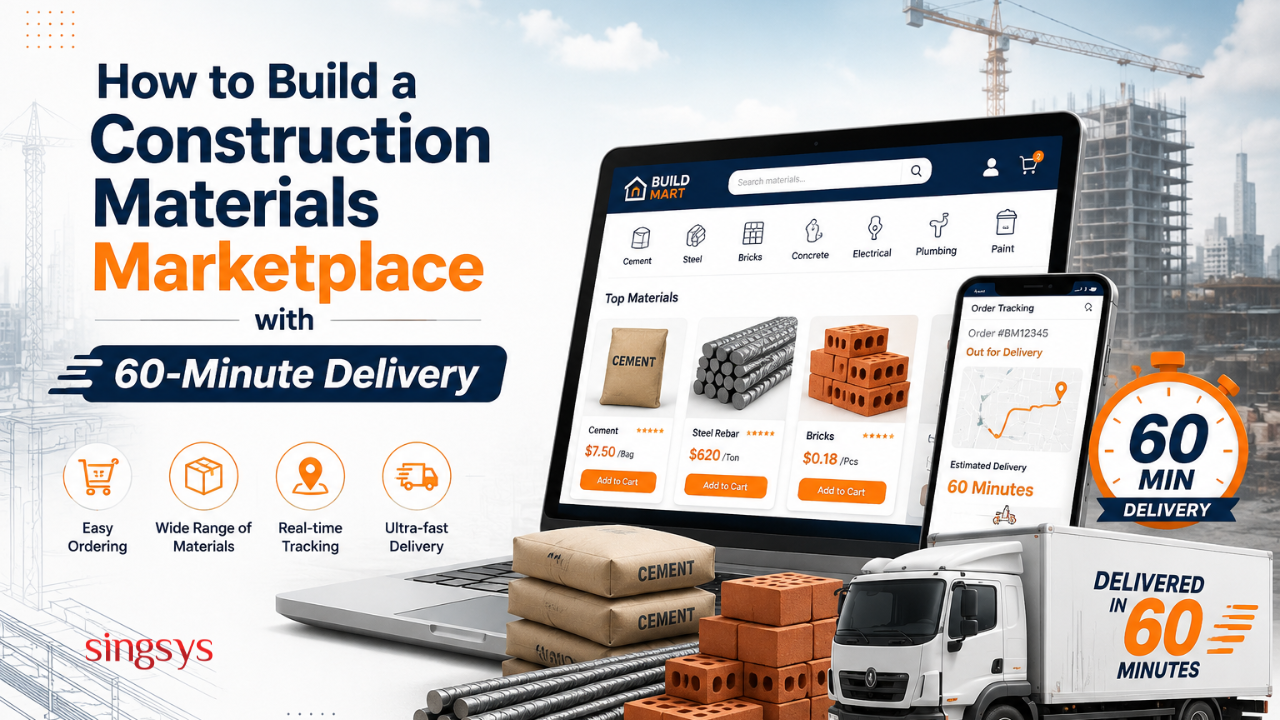
The construction industry is changing quickly. Contractors, builders, interior designers and individual customers increasingly expect the same convenience from construction material suppliers that they get from modern e-commerce and quick-commerce platforms.
Instead of calling multiple suppliers, visiting stores or waiting several days for materials to arrive, customers want to search, compare, order and track products online.
This has created an interesting opportunity for businesses: construction materials marketplaces with fast, potentially 60-minute delivery.
But building such a platform is more complicated than creating a standard shopping app. Construction products are often bulky, heavy, location-sensitive and available in different quantities and specifications. The delivery model must therefore be designed alongside the marketplace itself.
In this guide, we explore how to build a construction materials marketplace with 60-minute delivery, the features you need, the technology involved and the key challenges businesses should consider.
A construction materials marketplace is a digital platform that connects customers with multiple suppliers or retailers through a single application.
Depending on the business model, customers may be able to purchase products such as:
Instead of operating as a traditional online store with one inventory source, a marketplace can bring together multiple suppliers and allow customers to order products based on availability, price, location and delivery time.
A 60-minute delivery promise sounds simple from the customer’s perspective:
Search → Order → Receive
Behind the scenes, however, the platform needs to coordinate several processes almost simultaneously.
A typical order could involve:
Customer → Product search → Nearby supplier → Inventory verification → Order confirmation → Warehouse/store picking → Delivery assignment → Route optimisation → Customer delivery
For this reason, a quick-delivery construction marketplace needs strong inventory, logistics and location-management capabilities.
It may also be more practical to offer 60-minute delivery only for eligible products and service areas, rather than promising it for every product.
Before starting development, decide how the marketplace will operate.
Multiple suppliers list their products and fulfil customer orders.
The platform purchases and stores selected products in warehouses or fulfilment centres and manages delivery itself.
Some products come from company-operated inventory, while other products are fulfilled by third-party suppliers.
For quick commerce, a hybrid model can be particularly useful because high-demand products can be stocked locally while less frequently purchased or specialised materials can be sourced from partner suppliers.
Not every construction material is ideal for a 60-minute delivery model.
For example, small hardware items, electrical accessories, plumbing components, tools, adhesives and selected paint products may be easier to deliver quickly than large quantities of cement, steel or aggregates.
Your platform can therefore classify products into categories such as:
This provides customers with realistic delivery expectations while keeping logistics manageable.
A user-friendly customer application should make purchasing construction materials as straightforward as possible.
Customers should be able to search by product name, brand, specification, size, quantity and application.
Advanced filters can help users quickly find the right material.
Product pages should include:
For construction materials, accurate specifications are particularly important because purchasing the wrong product can cause costly project delays.
The app should identify which products are available near the customer’s delivery location.
This is essential for fast delivery because the closest supplier or fulfilment centre may determine whether a 60-minute delivery is possible.
Customers should be able to select quantities, review delivery charges, choose delivery slots and complete payments without unnecessary steps.
Once an order is placed, customers should be able to see its status—from confirmation and preparation to dispatch and delivery.
The marketplace is only as strong as its supplier network.
Suppliers should have a dedicated dashboard or application where they can:
Real-time inventory updates are particularly important. Showing a product as available when it has already sold out can quickly damage customer trust.
The delivery engine is the heart of a 60-minute marketplace.
The system should consider:
The platform can then assign an appropriate delivery partner and generate an efficient route.
For larger or heavier construction materials, businesses may need different vehicle types rather than relying entirely on two-wheelers.
Fast delivery depends heavily on inventory accuracy.
Your platform should ideally synchronise inventory across suppliers, warehouses and fulfilment locations.
When a customer places an order, the system should quickly determine:
What is available? Where is it located? How much can be delivered? Which fulfilment point can meet the promised delivery time?
Inventory systems can also support low-stock alerts, automated stock updates and demand forecasting.
Construction purchases can range from small hardware orders to high-value bulk transactions.
Depending on the target market, the application can support:
For B2B customers, invoicing and transaction history can also become valuable features.
The admin panel should give the business complete visibility into the platform.
Administrators may need to manage:
A central dashboard can help management monitor order volumes, delivery performance, popular products and supplier activity.
The technology stack will depend on the platform’s scale, integrations and business requirements.
A typical architecture may include:
Mobile/Web: React Native, Flutter, React or similar technologies
Backend: Node.js, Python, Java or another scalable backend framework
Database: PostgreSQL, MySQL, MongoDB or a combination depending on requirements
Cloud: AWS, Google Cloud or Microsoft Azure
Maps & Location: Mapping and geolocation APIs
Payments: Payment gateway integrations appropriate to the target market
Notifications: Push notifications, SMS and email
Analytics: Product, customer and delivery analytics platforms
The architecture should be designed for scalability because order volume can increase significantly as the marketplace expands into new locations.
Artificial intelligence can add value beyond basic automation.
For example, AI can help with:
Analyse historical orders to predict which products are likely to be needed in particular locations.
Suggest related products based on customer searches and previous purchases.
Allow users to find products even when they use different terms, abbreviations or descriptions.
Use location, traffic and historical delivery information to provide more accurate estimated delivery times.
AI-powered assistants can answer common questions about products, orders, delivery and account management.
A construction quick-commerce platform comes with challenges that traditional e-commerce businesses may not face.
Large materials require appropriate vehicles, handling processes and delivery planning.
A 60-minute promise becomes difficult to maintain when supplier inventory data is outdated.
Fast delivery can increase operational costs. Businesses need to determine which orders justify express fulfilment and how delivery fees should be structured.
Construction products often have technical specifications that customers need to understand before purchasing.
A 60-minute delivery model works best when fulfilment locations and suppliers are sufficiently close to customers.
The marketplace needs reliable suppliers who can confirm orders and prepare them quickly.
There is no single development cost because the budget depends on the application’s scope.
Factors that influence cost include:
A basic marketplace with standard e-commerce functionality will naturally cost less than a multi-vendor platform with real-time inventory, route optimisation, multiple delivery models and AI-powered features.
The best approach is to define the MVP first and gradually introduce advanced capabilities.
Building this type of platform requires more than e-commerce expertise. Developers need to understand marketplace architecture, logistics, location services, inventory systems and mobile applications.
Businesses looking for an ecommerce app development company in India should evaluate its experience with multi-vendor platforms, scalable architectures, payment integrations and marketplace workflows.
For businesses targeting Southeast Asian markets, working with a quick commerce app development company in Singapore can also provide useful understanding of local digital commerce expectations, delivery models and customer behaviour.
Most importantly, if your business is specifically focused on construction technology, partnering with a Construction Material app development company can help ensure that the platform accounts for industry-specific requirements such as product specifications, bulk ordering, supplier management and logistics.
You do not need to launch every feature on day one.
A practical MVP could include:
Once the platform has real customers and operational data, advanced features such as AI recommendations, demand forecasting, automated pricing and sophisticated route optimisation can be introduced.
A construction materials marketplace with 60-minute delivery has the potential to bring much-needed convenience to an industry where material availability and timing can directly affect project schedules.
However, the real challenge is not simply building an app. It is creating an ecosystem where products, suppliers, inventory, customers and delivery operations work together in real time.
Businesses that approach the project strategically—starting with the right products, realistic delivery zones, reliable suppliers and a scalable technology foundation—can create a marketplace that is convenient for customers and sustainable to operate.
Whether you are planning a construction marketplace in India, Singapore or another market, the right technology partner can help turn the concept into a scalable digital commerce platform.
Read More Blog Posts:






May 7th, 2026
If you run an online store—or plan to start one—you already know the truth: everyone is on their phone. In 2026, if your business isn’t on a mobile screen, it’s […]
Jan 22nd, 2026
Large retail brands like Home Depot have set a strong example of how a powerful eCommerce app can transform customer experience and boost sales. From browsing thousands of products to […]
Jan 15th, 2026
Magento has established itself as one of the most powerful and flexible eCommerce platforms in the world. Trusted by small businesses, growing brands, and large enterprises alike, Magento offers unmatched […]