Artificial intelligence has changed the way software is built. From generating code and writing tests to debugging applications and analysing technical documentation, AI tools are becoming a regular part of modern development workflows.
But in 2026, development teams are facing a more important question: Should we use an AI copilot, or is it time to move towards agentic AI?
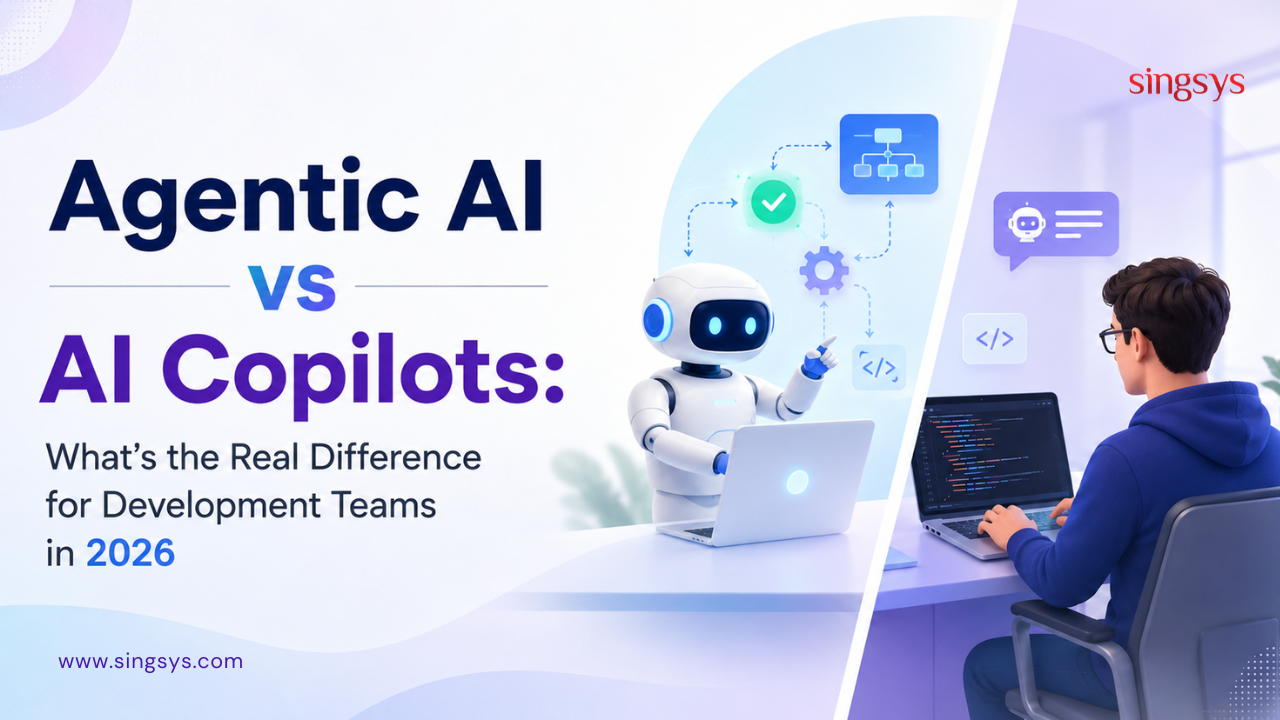
Although the two technologies are often discussed together, they are not the same. AI copilots are primarily designed to assist developers with specific tasks, while agentic AI can take a more autonomous approach to completing multi-step development objectives.
Understanding this difference can help businesses choose the right technology, development approach and level of automation for their teams.
An AI copilot is an AI-powered assistant that works alongside a developer. Think of it as an intelligent pair programmer that can provide suggestions, generate content or help solve problems while the developer remains actively involved in the process.
For example, a developer might ask a copilot to:
Generate a function based on a written requirement
Explain an unfamiliar piece of code
Suggest ways to fix a bug
Write unit tests
Convert code from one programming language to another
Create SQL queries
Generate documentation
Suggest improvements to existing code
The developer generally reviews the AI’s output, makes decisions and determines what should happen next.
This makes copilots particularly useful when teams want to increase developer productivity without giving AI complete control over the development workflow.
How AI Copilots Work
The typical workflow looks something like this:
Developer gives instruction → AI generates suggestion → Developer reviews → Developer modifies or approves → Code is implemented
The human remains at the centre of the process.
For example, if a developer says, “Create an API endpoint for user registration,” the copilot may generate the required code. However, the developer still needs to check authentication, validation, database interactions, security and integration before accepting it.
What Is Agentic AI?
Agentic AI takes the concept further.
Instead of simply responding to individual prompts, an AI agent can understand a broader objective, break it into smaller tasks, use available tools and work through multiple steps to achieve the desired outcome.
For a development team, that could mean giving an agent a goal such as:
“Add a password-reset feature to the application, write tests, update the API documentation and prepare the changes for review.”
An agentic system could potentially:
Analyse the existing codebase
Identify relevant files
Plan the implementation
Write or modify code
Run tests
Identify failures
Debug issues
Run the tests again
Update documentation
Prepare a code change for human review
The important difference is autonomy.
An AI copilot generally waits for the developer to provide the next instruction. An AI agent can decide what steps are necessary to move towards a larger objective.
Agentic AI vs AI Copilots: The Core Difference
The easiest way to understand the distinction is to think about assistance versus execution.
Area
AI Copilot
Agentic AI
Primary role
Assists developers
Completes objectives
Autonomy
Relatively low
Higher
Workflow
Prompt → response
Goal → plan → actions → result
Human involvement
Frequent
Primarily oversight and approval
Task complexity
Individual tasks
Multi-step workflows
Tool usage
Usually developer-directed
Can select and use tools
Decision-making
Limited
More autonomous
Best use case
Productivity assistance
Workflow automation
However, this does not mean that agentic AI will simply replace AI copilots. In many development environments, the two can work together.
Why Agentic AI Is Gaining Attention in 2026
Software development has become increasingly complex.
Modern applications may involve cloud infrastructure, APIs, databases, third-party services, microservices, security systems, CI/CD pipelines and multiple programming languages.
Developers are therefore spending time on more than writing code. They also need to investigate problems, understand dependencies, run tests, review pull requests and manage repetitive development processes.
Agentic AI has the potential to automate parts of these workflows.
For example, instead of asking an AI tool to write a test and then manually run it, a development agent could generate the test, execute it, analyse the results and make adjustments when appropriate.
This creates a shift from:
“AI helps me write code.”
to:
“AI helps me complete a development task.”
That distinction could have a significant impact on software engineering teams.
Where AI Copilots Still Make More Sense
Despite the excitement around agentic AI, copilots remain highly valuable.
For many teams, the biggest benefit of AI is not complete automation. It is giving developers faster access to useful assistance while keeping humans firmly in control.
1. Code Generation
Copilots can quickly generate repetitive functions, components and boilerplate code.
2. Code Explanation
Developers working with legacy or unfamiliar code can use AI to understand what a particular function or module does.
3. Debugging Assistance
An AI copilot can analyse an error message or code snippet and suggest possible causes and solutions.
4. Learning and Documentation
Developers can ask questions about frameworks, APIs, libraries and programming concepts without constantly switching between different resources.
5. Developer Control
Because the developer typically initiates each action, copilots can be easier to introduce into teams that are cautious about AI-driven changes.
Where Agentic AI Can Deliver More Value
Agentic AI becomes particularly interesting when a task involves multiple connected actions.
Software Testing
An agent could potentially identify areas that need testing, create test cases, run them and investigate failures.
Bug Resolution
Rather than simply explaining an error, an agent could inspect relevant files, identify a likely cause, propose a fix, run tests and prepare the change for review.
Code Refactoring
Agents could analyse parts of a codebase, identify repetitive patterns and assist with larger refactoring tasks.
Documentation
An agent could review recent code changes and update relevant technical documentation automatically.
DevOps Workflows
With carefully controlled permissions, agentic systems could assist with deployment preparation, monitoring analysis and incident investigation.
Project Maintenance
Agents can also help identify outdated dependencies, review issues and handle repetitive maintenance tasks.
Does Agentic AI Mean Developers Will Become Less Important?
Not necessarily.
In fact, the role of developers may evolve rather than disappear.
As AI becomes better at handling repetitive implementation tasks, developers can spend more time on areas where human judgement is particularly valuable, including:
Architecture
Product decisions
Security
System design
Performance optimisation
User experience
Business logic
Code review
Risk management
The developer increasingly becomes an orchestrator and reviewer, rather than someone who manually performs every development action.
This is similar to the evolution of other development tools. Automation did not eliminate software engineers; it changed how they spent their time.
The Security Question
The move towards agentic AI also introduces new risks.
An AI copilot that suggests code is one thing. An AI agent that can access repositories, databases, APIs or deployment systems is another.
The more autonomy an AI system has, the more carefully organisations need to control what it can access and what actions it can perform.
Development teams should consider:
Permission management
Secure API access
Data privacy
Code review requirements
Audit logs
Human approval checkpoints
Secrets management
Testing and sandboxing
Protection against malicious instructions
Monitoring of AI-generated changes
A useful principle is:
Give AI the minimum access it needs to complete its task.
High-impact actions should also have appropriate human approval mechanisms.
Agentic AI and AI Copilots Can Work Together
The choice does not have to be either-or.
A modern development environment can combine both approaches.
For example, a developer might use an AI copilot during everyday coding while an agent handles a larger background task.
A simplified workflow could look like this:
Developer defines objective → Agent creates plan → Agent performs approved tasks → Copilot assists developer when needed → Automated tests run → Human reviews results → Changes are approved
This hybrid model can provide the productivity benefits of AI while maintaining human oversight.
How Should Development Teams Choose?
Before adopting an agentic AI solution, teams should look at the type of work they actually perform.
Choose an AI Copilot When:
Developers need coding assistance
Tasks are relatively small and well-defined
Human control is important
Teams are beginning their AI adoption journey
Developers frequently need explanations or suggestions
Consider Agentic AI When:
Tasks involve multiple development steps
Workflows are repetitive
Automated testing is available
The development environment has well-defined tools and processes
Teams can implement appropriate permissions and monitoring
There is a clear business case for greater automation
The key is not to adopt agentic AI simply because it is more advanced.
The right technology is the one that solves the right problem.
What Businesses Should Look for in an AI Development Company
For organisations planning to introduce AI into their software development process, choosing the right technology partner is equally important.
An experienced AI development company should look beyond simply adding an AI chatbot or coding assistant to an existing system.
The right partner should be able to understand the business workflow, identify suitable AI use cases and determine where automation can genuinely create value.
Important areas to evaluate include:
Experience with generative and agentic AI
AI integration with existing software
API and third-party tool integration
Data security and privacy
Cloud and infrastructure expertise
AI model selection
Workflow automation
Testing and monitoring
Human-in-the-loop systems
Scalability and long-term maintenance
A strong AI strategy starts with the business problem rather than the technology itself.
The Future of AI-Assisted Software Development
AI-assisted development is moving beyond simple code completion.
AI copilots have already shown how intelligent assistance can accelerate everyday development tasks. Agentic AI represents the next step towards systems that can reason through workflows, use tools and execute multiple actions towards a defined objective.
But greater autonomy also requires greater responsibility.
Development teams should not measure AI adoption simply by asking, “How much code can AI generate?”
A better question is:
“How much meaningful development work can AI help us complete safely and reliably?”
That shift in thinking will become increasingly important as AI agents become more capable.
Final Thoughts
The real difference between agentic AI and AI copilots comes down to autonomy, workflow and responsibility.
AI copilots act as intelligent assistants, helping developers write, understand and improve code. Agentic AI can go further by planning and executing multiple steps towards a broader development goal.
For many organisations, the best approach in 2026 will not be choosing one over the other. Instead, teams can combine copilots for developer assistance with carefully controlled AI agents for repetitive, multi-step workflows.
The future of software development is therefore unlikely to be about humans versus AI. It is more likely to be about developers and increasingly capable AI systems working together—with humans providing the judgement, direction and oversight that technology still needs.
Ready to Explore AI for Your Development Workflow?
Whether you are considering an AI copilot, building an autonomous development agent or integrating AI into an existing software product, the right strategy depends on your technical environment and business objectives.
Working with an experienced AI development company can help you identify practical use cases, select the right AI architecture and build solutions that are secure, scalable and aligned with your development goals.
Tanu Vishwakarma, a seasoned social media marketer, possesses a passion for promoting businesses online. She specialises in crafting creative strategies to captivate potential customers. Her dedication to staying updated on industry trends ensures that her methods are always effective. Tanu thrives on helping businesses shine in the digital realm.
Artificial intelligence has changed how people create, consume, and share information. From writing blog posts and business reports to generating news summaries and answering everyday questions, AI-generated content is now […]
Artificial intelligence is no longer limited to futuristic products or experimental projects. Businesses across industries are now using AI to automate repetitive work, understand customer behaviour, improve decision-making and create […]
The way people interact with technology is changing. For years, typing, tapping, and clicking were the standard ways to use digital products. Today, voice is becoming a natural part of […]