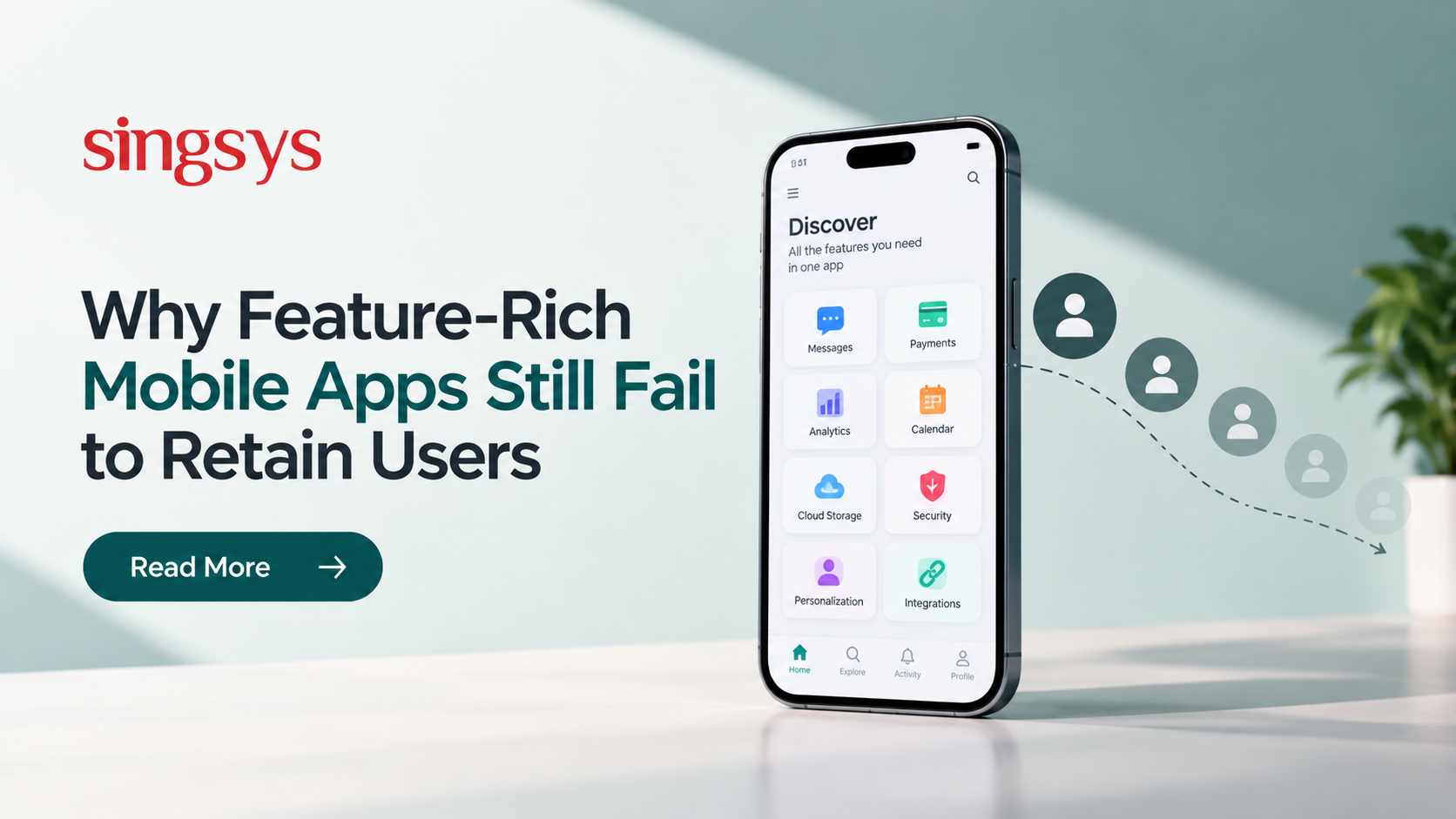
Building a mobile app with advanced features may attract users initially, but getting them to return regularly is a different challenge. Many businesses invest in sophisticated functionality, attractive interfaces, and innovative technologies, yet struggle to maintain consistent user engagement. Downloads may increase after launch, but active users gradually decline as people stop opening the app or uninstall it altogether.
The problem is often not a lack of features. Instead, it comes down to how effectively an app solves users’ problems, fits into their routines, and delivers a satisfying experience.
Understanding why feature-rich mobile apps fail at mobile app user retention can help businesses develop products that encourage long-term engagement rather than focusing solely on downloads and initial adoption.
1. Too Many Features Create Unnecessary Complexity
One of the most common mistakes in mobile app development is assuming that more features automatically create more value. Businesses may add multiple dashboards, advanced filters, AI assistants, customisation options, and integrations to make their apps stand out from competitors.
However, every additional feature introduces another decision for users. When the interface becomes crowded or navigation feels complicated, users may struggle to find the functionality they actually need.
For example, a shopping app with numerous categories, promotional banners, recommendation sections, and account options may overwhelm someone who simply wants to purchase a product.
How to improve retention: Prioritise features according to user needs. Keep essential actions easy to discover, organise secondary functionality logically, and introduce advanced options when users are ready for them. A focused experience often creates more value than an interface packed with unnecessary capabilities.
2. Poor Onboarding Prevents Users from Experiencing Value
First impressions significantly influence whether someone continues using a mobile app. If the onboarding process requires lengthy registration, excessive permissions, or multiple setup screens, users may leave before discovering its main benefits.
This becomes particularly problematic when an app introduces complex features without explaining how they work. Users should not have to spend considerable time learning the interface before completing their first meaningful action.
For instance, a personal finance app might offer budgeting tools, spending analytics, and automated savings recommendations. However, if users must complete a lengthy profile before seeing any useful insights, they may abandon the process.
How to improve retention: Make onboarding short, intuitive, and relevant. Allow users to explore suitable features before requesting unnecessary information. Use contextual guidance, simple instructions, and a clear first-use journey to help users experience value quickly.
The objective is to demonstrate why the app deserves a place on their device as early as possible.
3. The App Does Not Solve a Frequent or Important Problem
An app can work perfectly and still struggle with retention if users have little reason to return.
Some applications are designed around features rather than genuine user needs. Although these features may appear impressive during demonstrations, they might not address a problem users encounter frequently enough to justify repeated engagement.
Consider a travel app offering ticket bookings, hotel reservations, itinerary management, and destination recommendations. If its recommendations are irrelevant or its booking process provides little advantage over competing services, users may return only when absolutely necessary.
Not every app needs daily usage to be successful. However, its value proposition must align with how often users need the service.
How to improve retention: Identify the core problem the app solves and understand when users experience it. Build experiences around those moments, whether that means daily productivity, weekly financial planning, or occasional travel bookings.
Retention improves when an app becomes genuinely useful within the user’s existing habits.
4. Slow Performance and Technical Issues Damage Trust
Users may appreciate advanced functionality, but they rarely tolerate an app that loads slowly, crashes frequently, or behaves inconsistently.
Performance problems can affect even well-designed applications. Large images, inefficient database queries, excessive background processing, and poorly optimised APIs can increase loading times and reduce responsiveness.
Compatibility issues across devices and operating systems can create additional friction. If an app drains battery power, consumes excessive mobile data, or repeatedly loses user progress, people may quickly look for alternatives.
These problems are especially damaging because users often associate technical reliability with the credibility of the business behind the application.
How to improve retention: Test performance across different devices, network conditions, and operating system versions. Monitor crash reports, loading times, API response times, and application responsiveness. Regular maintenance and performance optimisation should remain priorities after launch.
A reliable experience gives users fewer reasons to abandon the app.
5. Personalisation Feels Irrelevant or Intrusive
Personalisation can improve mobile app engagement by making content, recommendations, and interactions more relevant to individual users. However, poorly implemented personalisation can have the opposite effect.
Repeatedly recommending irrelevant products, displaying content that does not match user preferences, or sending notifications based on incorrect assumptions can make an app feel disconnected from its audience.
Privacy concerns also matter. Users may become uncomfortable when an application requests permissions or collects information without clearly explaining why it is necessary.
How to improve retention: Use relevant behavioural insights to make experiences more helpful, while respecting user consent and privacy. Give people control over preferences and communication settings. Personalisation should reduce effort, not create discomfort.
When recommendations consistently reflect user needs, the app becomes more useful and engaging.
6. Notifications Become a Source of Frustration
Push notifications can bring users back to an app, but sending more notifications does not necessarily increase retention.
Frequent promotional messages, generic reminders, and poorly timed alerts can interrupt users without offering meaningful value. Over time, people may disable notifications or uninstall the application entirely.
For example, a fitness app that sends several daily reminders without considering a user’s activity patterns may become irritating rather than motivating.
How to improve retention: Make every notification relevant, timely, and useful. Segment users according to their preferences and behaviour, and establish reasonable communication limits. Whenever possible, allow users to choose the types of notifications they want to receive.
Notifications should support the user journey instead of becoming a substitute for a valuable product experience.
7. Businesses Ignore User Feedback and Behavioural Data
Mobile app user retention is not a one-time achievement. User expectations change, competitors introduce new experiences, and previously useful features may become less effective.
Businesses that focus exclusively on downloads and total registrations can overlook the reasons people stop using their applications. Without understanding user behaviour, development teams may continue investing in features that do little to improve engagement.
Useful indicators include Day 1, Day 7, and Day 30 retention, onboarding completion rates, session frequency, feature adoption, and uninstall trends. Analysing these metrics can reveal where users lose interest.
How to improve retention: Combine analytics with user feedback, usability testing, and customer support insights. Identify the stages where users disengage, investigate the underlying causes, and test targeted improvements.
Retention data becomes valuable when it informs specific product decisions rather than simply appearing in monthly reports.
8. The App Stops Evolving After Launch
Launching an application is only the beginning of its product lifecycle. User expectations, device capabilities, security requirements, and market conditions continue to evolve.
An app that receives few meaningful improvements may gradually become less competitive. Meanwhile, unresolved bugs, outdated interfaces, and missing integrations can reduce its usefulness.
However, frequent updates alone are not the answer. Adding features without a clear purpose can increase complexity without improving the experience.
Businesses should focus on continuous, evidence-based improvement rather than releasing changes simply to demonstrate activity.
Working with experienced mobile app development services providers can help businesses improve application performance, refine user journeys, introduce useful functionality, and maintain compatibility as requirements evolve.
For applications that rely on connected platforms, businesses may also benefit from custom software development services to integrate existing systems, streamline workflows, and support changing product requirements.
The goal is to make every update contribute to a better user experience.
How Businesses Can Improve Mobile App User Retention
Improving mobile app user retention requires a user-centred approach that connects product design, development, analytics, and ongoing optimisation.
Businesses can begin by following these principles:
Prioritise user needs: Build around real problems instead of adding features for the sake of differentiation.
Simplify key journeys: Make registration, navigation, and essential actions straightforward.
Optimise performance: Ensure the app remains responsive, reliable, and secure.
Measure meaningful outcomes: Track retention and engagement alongside downloads and acquisition.
Use feedback continuously: Learn why users stay, disengage, or uninstall the app.
Improve strategically: Release updates based on evidence and changing user expectations.
These practices help businesses create applications that deliver lasting value rather than relying on novelty to maintain attention.
Feature-rich mobile apps do not automatically achieve strong user retention. An application may offer impressive functionality, but complicated navigation, poor onboarding, technical problems, irrelevant notifications, and limited ongoing value can prevent users from returning.
The most successful mobile apps focus on making everyday interactions useful, reliable, and effortless. By understanding user behaviour, simplifying experiences, and continuously improving performance, businesses can turn initial downloads into sustained engagement.
Singapore’s tropical climate can change quickly, with bright sunshine giving way to sudden showers, thunderstorms, or heavy rainfall. For residents, commuters, tourists, and businesses, reliable weather information can make everyday […]
Mobile applications have become an essential investment for businesses in Singapore looking to improve customer engagement, streamline operations, and expand their digital presence. From startups launching their first product to […]
India’s grocery shopping landscape is rapidly becoming more digital, creating opportunities for startups to build convenient and scalable grocery delivery platforms. Consumers increasingly expect to discover products, compare prices, place […]