The search landscape is evolving rapidly. With the introduction of AI-powered search experiences such as Google’s AI Overviews (AIO), businesses and website owners must rethink how they optimise their content for visibility. Traditional SEO practices remain important, but they are no longer enough on their own.
Google’s AI Overview generates concise answers by analysing content from multiple sources across the web. To help AI systems understand website content more effectively, structured data and schema markup have become increasingly valuable.
Schema markup acts as a translator between your website and search engines. It provides clear context about your content, making it easier for Google to understand, organise, and potentially feature your information in AI-generated results.
In this guide, we will explore how schema markup works, why it matters for Google AI Overviews, and the most effective schema markup strategies to improve your search visibility.
Schema markup is a type of structured data added to a website’s code that helps search engines understand the meaning and context of content.
Instead of simply reading text, search engines can identify specific elements such as:
Business information
Products
Services
Articles
FAQs
Reviews
Events
Authors
Recipes
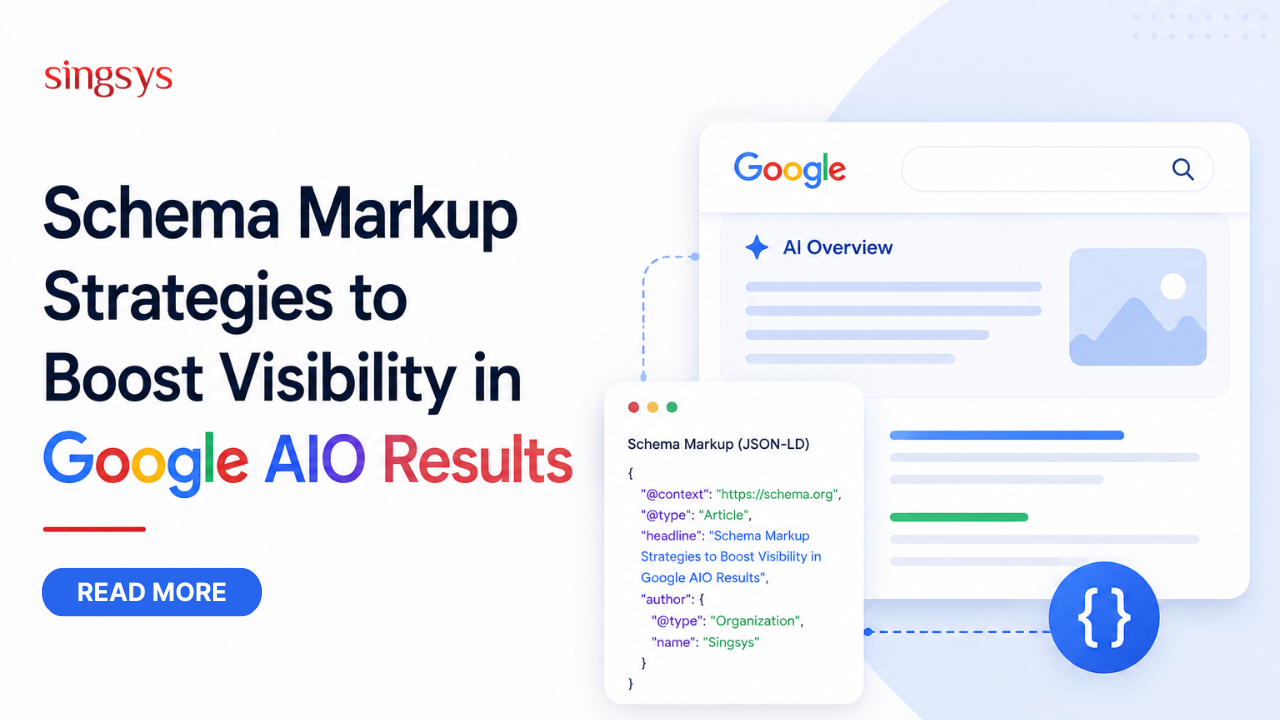
Schema markup uses a standard vocabulary developed by Schema.org and is typically implemented using JSON-LD format.
Example of Schema Markup
If a webpage discusses mobile app development services, schema markup can tell Google that the page is specifically about a service rather than a general article.
This additional context improves content interpretation and can enhance search result visibility.
Why Schema Markup Matters for Google AI Overviews
Google AI Overviews are designed to provide quick, accurate, and comprehensive answers to users.
To generate these responses, Google’s AI systems need to understand:
What a page is about
Who created it
Whether it is trustworthy
How information is structured
Which content directly answers user queries
Schema markup helps provide these signals.
Benefits of Schema for AI Overview Visibility
Improved Content Understanding
Structured data allows AI systems to interpret content more accurately.
Better Context Recognition
Schema provides relationships between entities, topics, products, services, and authors.
Increased Search Visibility
Pages with proper schema often qualify for rich results and enhanced search features.
Enhanced E-E-A-T Signals
Schema can reinforce Experience, Expertise, Authoritativeness, and Trustworthiness.
Better AI Content Extraction
Google’s AI can identify key facts and summaries more efficiently.
Understanding How Google AI Overviews Use Structured Data
While Google has not confirmed that schema directly guarantees inclusion in AI Overviews, structured data significantly improves content comprehension.
AI systems rely on:
Content quality
Contextual understanding
Topic relationships
Entity recognition
Trust signals
Schema contributes to all these factors.
Think of schema as helping Google connect the dots faster.
Essential Schema Types for Google AIO Visibility
Article Schema
Article schema is one of the most important structured data types for blogs and informational content.
It helps Google identify:
Headline
Author
Publication date
Article category
Main image
Best Practices
Include author information
Add publication and update dates
Use descriptive headlines
Ensure content matches schema data
FAQ Schema
FAQ schema helps highlight common questions and answers.
Google AI Overviews often surface concise answers to user questions.
Benefits
Improves content clarity
Supports conversational search
Enhances user experience
Increases answer visibility
How-To Schema
For instructional content, How-To schema provides step-by-step guidance.
Examples include:
How to build a mobile application
How to optimise website speed
How to implement SEO strategies
Google can better understand procedural content using this schema type.
Organization Schema
Organization schema helps establish business credibility.
It includes:
Business name
Logo
Website URL
Contact information
Social profiles
This strengthens brand authority and entity recognition.
Local Business Schema
Businesses serving specific locations should implement Local Business schema.
This includes:
Address
Phone number
Opening hours
Service area
Local relevance can improve visibility in AI-powered local search experiences.
This information can influence product-related AI-generated answers.
Review Schema
Review markup adds credibility and trust signals.
Google values genuine user feedback when evaluating content quality.
Service Schema
Service pages often lack structured data implementation.
Service schema can help define:
Type of service
Service provider
Geographic area
Description
This is particularly useful for:
Web development services
Mobile app development services
SEO services
Digital marketing services
AI development services
Advanced Schema Strategies for Better AIO Visibility
Build Strong Entity Relationships
Google increasingly focuses on entities rather than keywords.
Schema can help connect:
Brand names
Services
Authors
Products
Locations
These relationships improve topical understanding.
Combine Multiple Schema Types
Many websites use only one schema type.
A better approach involves combining:
Article Schema
FAQ Schema
Organization Schema
Author Schema
This creates a richer content profile.
Use Author Schema
Google values expertise.
Author schema helps identify:
Author credentials
Professional experience
Social profiles
Published work
This can strengthen E-E-A-T signals.
Optimise Content for Conversational Queries
AI Overview often responds to natural language questions.
Schema should support content that answers:
What is?
How does?
Why does?
When should?
Which is best?
This aligns with AI-generated responses.
Create Topic Clusters
Schema works best when combined with topical authority.
Develop clusters around related topics such as:
AI and Technology
AI-powered website development
Generative AI solutions
AI chatbot development
Machine learning applications
SEO and Digital Marketing
Technical SEO services
On-page SEO optimisation
Content marketing strategies
Local SEO services
Development Services
Mobile app development
Custom software development
Web application development
E-commerce development
These clusters help Google understand expertise across broader subject areas.
Common Schema Markup Mistakes to Avoid
Using Incorrect Schema Types
Always choose schema that accurately represents the content.
Missing Required Fields
Incomplete schema may reduce effectiveness.
Marking Up Invisible Content
Google discourages schema for information not visible on the page.
Outdated Information
Keep schema updated when content changes.
Ignoring Validation
Use Google’s Rich Results Test and Schema Markup Validator to verify implementation.
Measuring the Impact of Schema Markup
Schema performance can be monitored using:
Google Search Console
Track:
Rich results performance
Click-through rates
Search impressions
Analytics Platforms
Monitor:
Organic traffic
User engagement
Conversion rates
SEO Tools
Evaluate:
Structured data errors
Schema opportunities
Search visibility improvements
Future Trends: Schema Markup and AI Search
AI-powered search is still evolving.
Future developments may include:
More Personalised Search Experiences
AI systems will rely heavily on structured information.
Enhanced Entity-Based Search
Schema will help establish brand identity and topical authority.
Improved Content Attribution
Author and organisation schema may become even more important.
Better AI Understanding
Structured data will continue helping AI interpret content accurately.
Businesses that invest in schema implementation today will be better prepared for future search innovations.
Conclusion
Schema markup has become an essential component of modern SEO. While it may not directly guarantee placement in Google AI Overviews, it significantly improves how search engines and AI systems understand your content.
From Article Schema and FAQ Schema to Organization and Service Schema, structured data provides valuable context that supports visibility, credibility, and discoverability.
As Google’s AI-powered search experiences continue to expand, businesses must move beyond traditional SEO and focus on creating content that is both human-friendly and machine-readable.
By implementing the right schema markup strategies, strengthening entity relationships, and building topical authority, organisations can improve their chances of appearing in AI-generated search experiences and maintaining long-term search visibility.
If your business wants to maximise visibility in AI-powered search, investing in professional SEO services, technical SEO optimisation, AI-driven digital solutions, and structured data implementation can help build a stronger foundation for future growth.
Frequently Asked Questions
1. What is schema markup in SEO?
Schema markup is structured data added to a webpage that helps search engines better understand content and display enhanced search results.
2. Does schema markup help with Google AI Overviews?
While schema does not directly guarantee inclusion, it improves content understanding and provides context that can support AI-generated search visibility.
3. Can schema markup improve rankings?
Schema markup is not a direct ranking factor, but it can improve click-through rates, content understanding, and search visibility.
4. What is the best schema for service-based businesses?
Service Schema, Organization Schema, Local Business Schema, and FAQ Schema are highly recommended for service providers.
5. How do I check if my schema markup is working?
You can use Google’s Rich Results Test and Schema Markup Validator to verify structured data implementation.
6. Is schema markup important for future SEO?
Yes. As AI-powered search continues to evolve, structured data will play an increasingly important role in helping search engines understand and surface content.
Tanu Vishwakarma, a seasoned social media marketer, possesses a passion for promoting businesses online. She specialises in crafting creative strategies to captivate potential customers. Her dedication to staying updated on industry trends ensures that her methods are always effective. Tanu thrives on helping businesses shine in the digital realm.
Allocating a B2B marketing budget is an important decision for businesses looking to generate qualified leads, increase brand visibility, and build a consistent sales pipeline. With multiple digital marketing channels […]
When optimising a website for search engines, many businesses focus on keywords, backlinks, page speed and meta descriptions. But there is another simple element that deserves attention: the H1 tag. […]
For years, Google Ads has been one of the first platforms marketers think about when they hear “paid search.” It remains a powerful channel, but the paid search landscape is […]