Allocating a B2B marketing budget is an important decision for businesses looking to generate qualified leads, increase brand visibility, and build a consistent sales pipeline. With multiple digital marketing channels available, deciding how much to invest in SEO, Google Ads, and social media can be challenging.
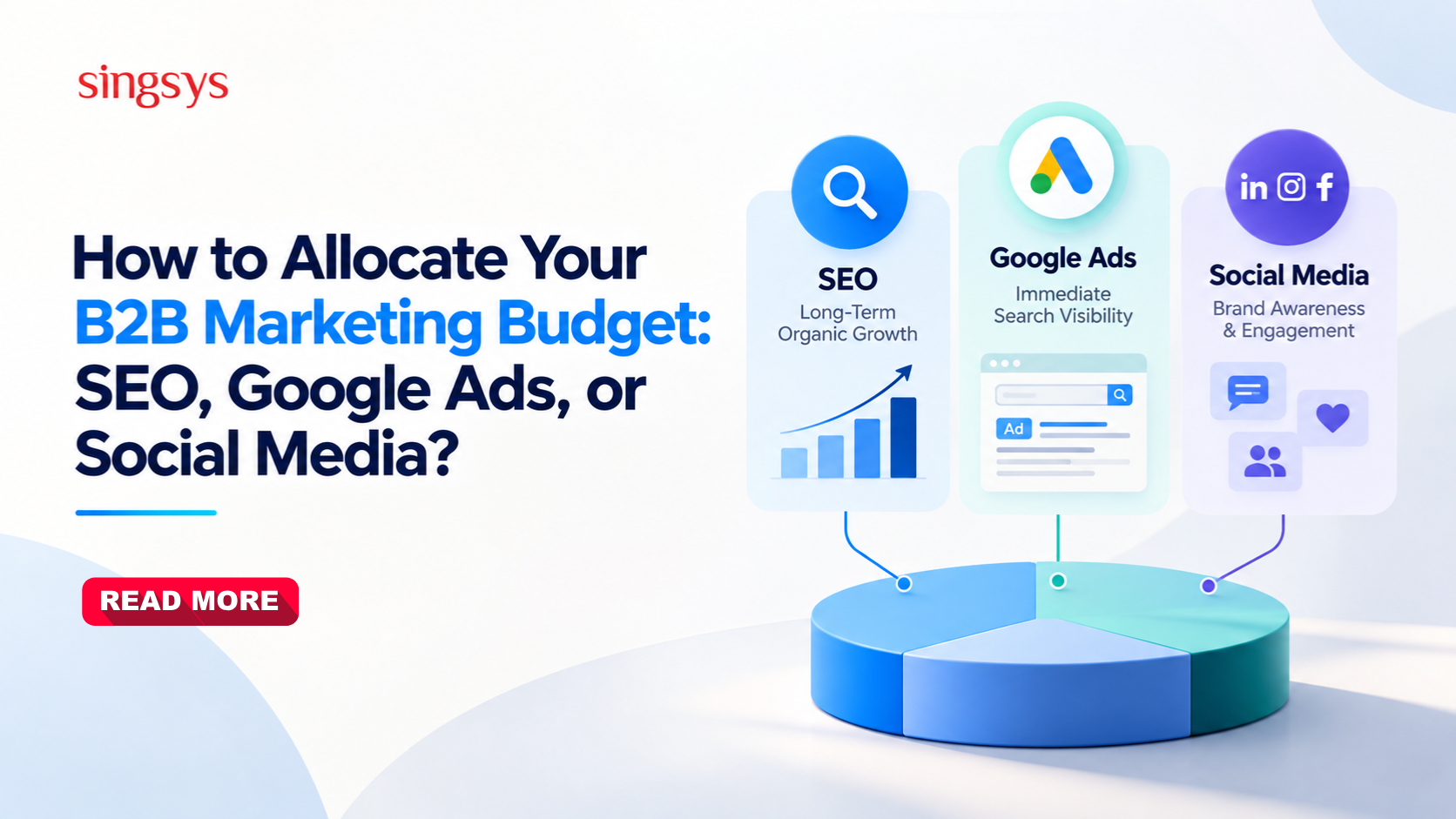
Each channel serves a different purpose. SEO helps businesses attract relevant organic traffic over time, Google Ads captures demand from people actively searching for solutions, and social media supports brand awareness, engagement, and relationship building.
The right approach is not necessarily choosing one channel over another. It is understanding your business objectives, sales cycle, target audience, and available resources to distribute your B2B marketing budget effectively.
1. Understand Your B2B Marketing Goals Before Allocating Budget
Before dividing your budget across different channels, define what your digital marketing activities need to achieve. B2B companies may prioritise different objectives depending on their growth stage, industry, and sales pipeline.
Common B2B marketing goals include:
Generating qualified leads and enquiries
Increasing website traffic from relevant decision-makers
Building brand awareness in target industries
Improving conversion rates and customer acquisition
Supporting sales teams with relevant prospects
Strengthening long-term organic visibility
For example, a new B2B software company may need immediate enquiries while establishing its online presence. An established IT services company may focus on organic search growth, stronger brand authority, and improving lead quality.
Your budget allocation should reflect these priorities rather than following a fixed percentage for every business.
2. Allocate Budget to SEO for Long-Term Organic Growth
Search engine optimisation (SEO) helps B2B businesses attract potential customers who are researching products, services, and solutions online. It focuses on improving website visibility through relevant keywords, useful content, technical improvements, and authority building.
For businesses with longer sales cycles, SEO can support multiple stages of the buying journey, from early research to vendor comparisons.
Where to Invest Your SEO Budget
A practical B2B SEO budget may cover:
Technical SEO: Improving website speed, crawlability, indexing, and mobile usability.
On-page SEO: Optimising service pages, landing pages, headings, and metadata.
Content marketing: Creating industry blogs, detailed guides, case studies, and solution pages.
Off-page SEO: Building relevant backlinks and strengthening website authority.
Conversion optimisation: Improving calls to action, enquiry forms, and content journeys.
SEO is particularly useful when your target audience regularly searches for solutions and your business can consistently publish relevant, high-quality content.
However, organic visibility generally takes time to build. Businesses should evaluate SEO through qualified organic traffic, relevant keyword visibility, enquiries, and assisted conversions rather than expecting immediate results.
3. Invest in Google Ads for Immediate Search Visibility
Google Ads can help B2B businesses reach potential customers who are actively searching for specific products or services. Unlike SEO, which requires time to build rankings, paid search campaigns can provide visibility as soon as they are approved and launched.
For example, an IT company targeting keywords such as “mobile app development company Singapore” or “custom software development services” can use search advertising to reach businesses researching development partners.
Where to Invest Your Google Ads Budget
Consider allocating spending across:
Search campaigns: Target high-intent keywords related to your services.
Competitor and alternative searches: Reach users researching different providers or solutions, where permitted and appropriate.
Remarketing: Re-engage eligible website visitors through suitable Google Ads campaign types.
Landing page optimisation: Improve the relevance of landing pages, forms, messaging, and calls to action.
Conversion tracking: Measure qualified enquiries and meaningful actions rather than clicks alone.
Google Ads can be useful when your business needs to generate enquiries within a defined timeframe or test demand for a particular service.
However, competitive B2B keywords can be expensive, and a high number of clicks does not guarantee qualified leads. Monitor cost per qualified lead, conversion rate, lead quality, and eventual sales outcomes.
4. Use Social Media to Build B2B Awareness and Trust
Social media plays an important role in B2B marketing by helping businesses build credibility, communicate expertise, and maintain relationships with potential customers.
LinkedIn is particularly relevant for many B2B companies because of its professional audience and business-focused content environment. Other platforms may also be useful depending on your industry, audience, and content strategy.
Where to Invest Your Social Media Budget
Your social media investment may include:
Organic content: Share industry insights, company updates, service information, and educational posts.
Paid social campaigns: Promote relevant content, events, and lead-generation offers to suitable audiences.
Thought leadership: Publish expert perspectives, technical explainers, and practical business advice.
Creative production: Develop graphics, short videos, carousels, and customer success stories.
Community engagement: Participate in relevant discussions and respond to audience questions.
Social media is especially useful when your offering requires trust, education, or repeated exposure before a prospect is ready to contact your company.
Its impact may not always appear as a direct last-click conversion. Track relevant engagement, qualified website visits, lead quality, and its contribution to the wider customer journey.
5. How to Divide Your B2B Marketing Budget
There is no universal budget split that works for every B2B company. However, an initial allocation can help businesses organise their spending and establish a baseline for testing.
For a B2B company balancing immediate lead generation with long-term growth, one illustrative starting allocation could be:
SEO: 40% of the budget
Invest in technical improvements, service-page optimisation, content creation, and authority building. This allocation supports sustainable organic visibility and can build value over time.
Google Ads: 35% of the budget
Focus on high-intent search campaigns, relevant landing pages, and conversion tracking. Use the initial results to identify which services and keywords generate qualified enquiries.
Social Media: 25% of the budget
Invest in organic content, professional creative assets, audience engagement, and selective paid campaigns. Prioritise platforms where your decision-makers are active.
These percentages are a planning example, not a benchmark or recommended split for every company. A business with strong organic visibility but limited immediate leads may distribute spending differently from a new business that needs to test demand.
6. Measure Performance and Adjust Your Budget Regularly
Effective B2B marketing budget allocation requires continuous measurement. Review performance across channels and assess whether each one is contributing to business outcomes.
Google Ads: Cost per lead, conversion rate, qualified lead rate, and customer acquisition cost.
Social media: Relevant engagement, referral traffic, lead quality, and campaign-assisted conversions.
Overall marketing: Cost per qualified opportunity, pipeline contribution, sales conversion rate, and return on marketing investment.
Avoid making budget decisions based on a single metric. For example, a campaign generating inexpensive leads may still underperform if those leads rarely match your ideal customer profile.
Review performance monthly, while allowing sufficient time for longer B2B sales cycles and channel-specific results to become clearer.
7. Build an Integrated B2B Digital Marketing Strategy
SEO, Google Ads, and social media are more effective when they support a coordinated marketing strategy.
SEO content can answer questions prospects encounter during their research. Google Ads can direct high-intent users to relevant service pages. Social media can distribute useful content, reinforce expertise, and maintain visibility among target audiences.
For example, a B2B technology company can publish a detailed guide about custom software development, promote a related high-intent service page through Google Ads, and share key insights on LinkedIn.
This integrated approach helps create multiple relevant touchpoints without treating each channel as an isolated activity.
Make Your B2B Marketing Budget Work Towards Measurable Growth
Allocating your B2B digital marketing budget effectively means balancing immediate opportunities with long-term business development. SEO can strengthen organic visibility, Google Ads can capture active search demand, and social media can build awareness and trust among relevant decision-makers.
The most suitable distribution depends on your business goals, target audience, competitive environment, sales cycle, and existing marketing performance. Start with clear objectives, establish a measurable allocation, and adjust spending based on qualified leads and pipeline contribution.
With a structured strategy and regular optimisation, businesses can make more informed marketing investments and build a digital presence that supports sustainable growth.
When optimising a website for search engines, many businesses focus on keywords, backlinks, page speed and meta descriptions. But there is another simple element that deserves attention: the H1 tag. […]
For years, Google Ads has been one of the first platforms marketers think about when they hear “paid search.” It remains a powerful channel, but the paid search landscape is […]
Noida has quickly become one of the major business and technology hubs in the Delhi-NCR region. With startups, eCommerce brands, IT companies, real estate businesses, healthcare providers and established enterprises […]