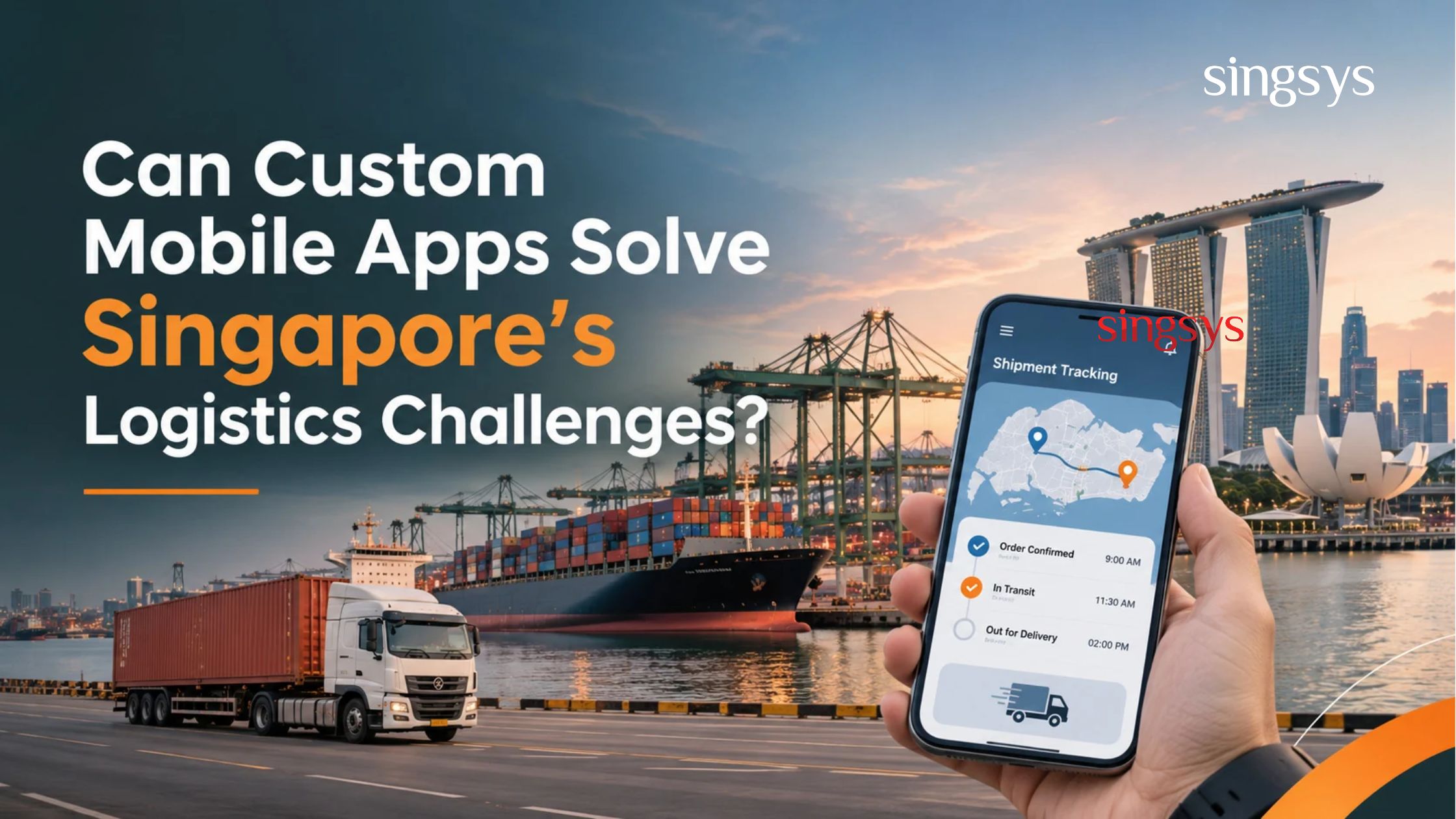
Singapore has established itself as one of the world’s leading logistics and transportation hubs. With its strategic location, advanced infrastructure, world-class port facilities, and strong global trade connections, the country plays a crucial role in international supply chains. However, as logistics operations become more complex, businesses face growing pressure to deliver goods faster, reduce operational costs, improve visibility, and meet increasing customer expectations.
Traditional logistics management methods are often insufficient to handle these demands. Manual documentation, disconnected systems, delayed communication, and limited real-time tracking can create inefficiencies throughout the supply chain.
This is where custom mobile applications can make a difference. By connecting logistics operations through intelligent, purpose-built digital solutions, businesses can improve coordination, automate routine processes, and gain better control over deliveries.
But can custom mobile apps genuinely solve Singapore’s logistics challenges? Let’s explore how they can help businesses build more efficient, transparent, and technology-driven logistics operations.
Understanding Singapore’s Major Logistics Challenges
Despite its advanced infrastructure, Singapore’s logistics sector faces several operational challenges that affect efficiency, delivery performance, and business growth.
1. Rising Operational and Delivery Costs
Logistics companies must manage expenses related to transportation, fuel, warehousing, vehicle maintenance, and labour. These costs can become particularly challenging for small and medium-sized enterprises (SMEs).
Without proper digital coordination, businesses may experience unnecessary trips, inefficient vehicle utilisation, and delays that increase the overall cost per delivery.
2. Limited Real-Time Shipment Visibility
Customers increasingly expect accurate delivery updates and transparent shipment tracking. However, businesses relying on manual tracking, spreadsheets, or disconnected systems may struggle to provide timely information.
A lack of real-time visibility also makes it difficult for logistics managers to identify delays, monitor shipment conditions, and respond quickly to unexpected disruptions.
3. Last-Mile Delivery Inefficiencies
Last-mile delivery remains one of the most demanding stages of logistics operations. Traffic conditions, delivery scheduling, incorrect addresses, and failed delivery attempts can affect overall performance.
Singapore’s urban environment makes efficient delivery planning particularly important. Businesses need better coordination between warehouses, drivers, dispatch teams, and customers to minimise unnecessary journeys.
4. Workforce and Resource Management
Managing drivers, warehouse employees, delivery schedules, and vehicles requires continuous coordination. Labour constraints and increasing delivery expectations can put additional pressure on logistics companies.
Without centralised management systems, allocating resources efficiently becomes difficult, potentially resulting in operational bottlenecks.
5. Fragmented Logistics Systems
Many logistics businesses use separate platforms for inventory management, fleet tracking, customer communication, and order processing.
When these systems do not communicate effectively, employees may need to enter the same information multiple times. This increases administrative workloads and creates opportunities for errors.
Singapore’s government has also recognised the importance of improving information flow, supply chain visibility, and digital collaboration across the logistics ecosystem.
How Can Custom Mobile Apps Address These Logistics Challenges?
Custom mobile applications offer businesses an opportunity to connect different logistics activities through a centralised digital platform. Unlike generic applications, these solutions can be developed around specific operational requirements, workflows, and business objectives.
Here are some practical ways they can improve logistics management in Singapore.
1. Real-Time Shipment Tracking and Monitoring
A custom logistics application can provide real-time shipment visibility by integrating GPS technology and tracking systems.
Logistics managers can monitor vehicle locations, check delivery progress, and identify potential delays through a central dashboard. Customers can also receive automated notifications about order confirmation, dispatch, estimated arrival times, and successful deliveries.
This improves transparency while reducing the need for repeated phone calls and manual status updates.
For businesses handling high-value, time-sensitive, or temperature-sensitive shipments, additional monitoring features can provide better operational control.
2. Intelligent Route Planning and Fleet Management
An effective fleet management application can help businesses optimise delivery routes using GPS data, traffic information, delivery locations, and vehicle availability.
Instead of depending entirely on manual route allocation, logistics managers can use digital tools to assign deliveries more efficiently.
Useful features include:
GPS-based vehicle tracking.
Route optimisation and navigation.
Driver allocation and scheduling.
Fuel consumption monitoring.
Vehicle maintenance reminders.
Delivery status updates.
These capabilities can help reduce unnecessary travel, improve vehicle utilisation, and support more predictable delivery schedules.
3. Automated Warehouse and Inventory Management
Warehouse operations involve several interconnected activities, including receiving goods, checking inventory, processing orders, and preparing shipments.
A custom warehouse management application can simplify these processes through barcode scanning, QR code integration, digital stock records, and automated inventory updates.
For example, when warehouse employees scan an item before dispatch, the application can automatically update inventory records and notify the relevant department.
This reduces manual data entry, minimises inventory discrepancies, and helps businesses maintain better stock visibility.
4. Improved Communication Between Drivers and Dispatch Teams
Communication gaps can create unnecessary delays, particularly when delivery schedules change or unexpected problems occur.
A dedicated driver application can connect delivery personnel with dispatch managers through instant notifications, digital task assignments, and in-app communication.
Drivers can access delivery instructions, update order statuses, upload proof of delivery, and report issues directly through their smartphones.
This eliminates dependency on scattered communication channels and ensures that important operational information remains accessible to authorised team members.
5. Digital Documentation and Proof of Delivery
Paper-based documentation can slow down logistics processes and make record management difficult.
Custom mobile applications can digitise activities such as delivery confirmations, invoices, shipment records, signatures, and proof-of-delivery documentation.
Drivers can capture customer signatures, upload delivery photographs, and submit digital records immediately after completing a delivery.
These records can be stored centrally, making it easier for businesses to retrieve information, resolve disputes, and maintain accurate delivery histories.
6. AI-Powered Logistics and Predictive Insights
Artificial intelligence can make logistics applications more intelligent by helping businesses analyse operational data and identify patterns.
For instance, AI-powered features can help predict delivery delays, forecast inventory requirements, identify inefficient routes, and estimate future demand.
Businesses can also integrate AI chatbots to answer common customer queries about shipment status, delivery schedules, and order information.
Although AI cannot eliminate every supply chain disruption, it can support faster decision-making and help logistics teams prepare for potential challenges.
Essential Features to Include in a Custom Logistics Mobile App
The functionality of a logistics application should depend on the company’s size, operational model, and target users. However, certain features can provide significant value across different logistics businesses.
Feature
Business Benefit
GPS Tracking
Provides real-time vehicle and shipment visibility
Route Optimisation
Supports efficient delivery planning
Inventory Management
Improves stock accuracy and monitoring
Push Notifications
Keeps customers and employees informed
Digital Proof of Delivery
Simplifies delivery verification
Analytics Dashboard
Helps monitor operational performance
AI Integration
Supports predictive insights and automation
Role-Based Access
Protects sensitive business information
A well-planned custom mobile app development strategy can bring these capabilities together in a solution designed around the company’s existing logistics ecosystem.
Why Should Singapore Logistics Businesses Invest in Custom App Development?
Ready-made logistics applications may work for businesses with standard requirements. However, companies managing specialised transportation, multiple warehouses, complex delivery networks, or industry-specific workflows may require greater flexibility.
Custom applications offer several advantages:
Business-Specific Functionality: Applications can be designed around existing workflows instead of forcing employees to adapt to generic software.
Seamless System Integration: Mobile applications can connect with ERP, CRM, warehouse management, payment gateways, and other business systems through suitable APIs.
Scalability: Businesses can introduce additional features, support more users, and expand operations as their requirements evolve.
Enhanced Security: Role-based permissions, secure authentication, encryption, and controlled data access can help protect sensitive operational information.
Better Customer Experience: Customers benefit from shipment visibility, automated updates, faster communication, and convenient service access.
However, successful implementation requires more than developing an application. Businesses must consider integration requirements, employee training, data security, infrastructure, and ongoing maintenance.
The Future of Logistics in Singapore: Mobile Technology and Digital Transformation
Singapore’s logistics industry is moving towards more connected, automated, and data-driven operations. Government initiatives such as the Logistics Industry Digital Plan and Singapore Trade Data Exchange (SGTraDex) highlight the importance of digital collaboration and improved supply chain visibility.
Mobile applications can complement these developments by bringing operational information directly to the people who need it, whether they are warehouse employees, delivery drivers, logistics managers, or customers.
The next generation of logistics applications will likely combine mobile technology with AI, IoT sensors, cloud computing, and advanced analytics.
For example, IoT-enabled sensors can monitor temperature conditions during cold-chain transportation, while mobile applications can display alerts when shipments move outside predefined limits.
Similarly, AI-powered analytics can help businesses identify recurring delivery bottlenecks and make more informed resource allocation decisions.
The objective is not simply to digitise existing processes but to create a more connected logistics ecosystem.
Custom mobile applications cannot independently eliminate every challenge facing Singapore’s logistics industry. However, they can address several critical operational inefficiencies by improving shipment visibility, automating documentation, optimising fleet operations, and strengthening communication.
For logistics companies looking to remain competitive, investing in purpose-built mobile solutions can be an important step towards greater operational efficiency and long-term scalability.
At Singsys, we understand how technology can help businesses simplify complex operations and improve digital capabilities. Through mobile app development,web application development, and digital transformation solutions, Singsys helps businesses explore technology-driven approaches to their operational requirements.
As Singapore continues strengthening its position as a global logistics hub, businesses that embrace practical digital solutions will be better equipped to adapt to changing supply chain demands.
Singapore’s real estate market is becoming increasingly technology-driven. From residential condominiums and commercial buildings to serviced apartments and rental properties, managing real estate involves coordinating multiple activities, including tenant communication, […]
Building a mobile app with advanced features may attract users initially, but getting them to return regularly is a different challenge. Many businesses invest in sophisticated functionality, attractive interfaces, and […]
Singapore’s tropical climate can change quickly, with bright sunshine giving way to sudden showers, thunderstorms, or heavy rainfall. For residents, commuters, tourists, and businesses, reliable weather information can make everyday […]